
Quick Answer
A Tampa Bay AC lasts 12 to 15 years, not the 15 to 20 you see nationally. Runtime, humidity, and salt air are why, plus when to repair vs replace.
Start here before you book service
- ✓ Find the install year on the outdoor data plate. Age is the first number in every repair-vs-replace conversation.
- ✓ Count cooling months, not calendar years. A Florida system that runs nine months a year is not living a northern life.
- ✓ If you are within a few miles of salt water, budget a shorter life unless the coil is coated and rinsed.
- ✓ Use age times repair cost against $5,000 before you approve a large repair.
- ✓ Twice-a-year maintenance is what actually moves a system from 10 years to 15.
Sounds like you need a tech?
(813) 395-2324A Florida AC lasts 12 to 15 years, not 15 to 20
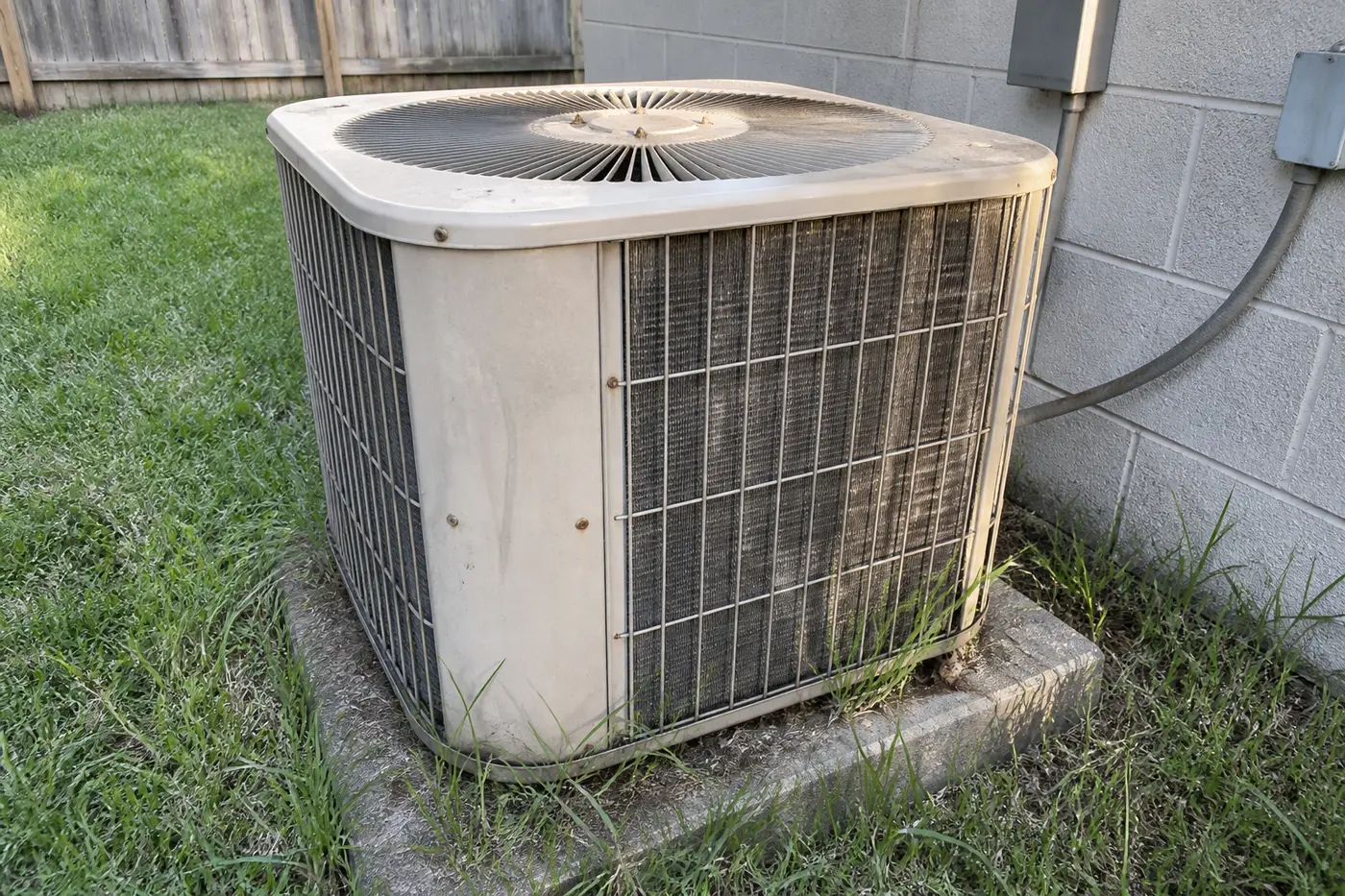
National manufacturer pages still quote 15 to 20 years. The U.S. Department of Energy's Home Cooling 101 handout lists the same 15 to 20 year life span for central air. That number assumes a cooling season, not a cooling year. In Wesley Chapel, New Tampa, and the rest of Tampa Bay, a heat pump or central AC runs close to nine months, with condenser head pressures in July and August that sit above the design temps printed on the data plate. Runtime hours wear a compressor faster than calendar years do.
On our trucks, a well-maintained system in inland Pasco or northern Hillsborough typically lands at 12 to 15 years before replacement is the honest conversation. Skip the tune-ups and we see 10 to 12. Closer to the Gulf, salt air can pull that lower even when the homeowner did everything else right. Those are field ranges from the homes we service, not a warranty promise.
Runtime and humidity wear the parts, not a weak brand
A 3-ton system in Minnesota might log about 600 cooling hours a year. The same size in Tampa Bay logs more than 2,200. That is why a capacitor, a contactor, and a condenser fan motor fail on a schedule that looks early if you grew up somewhere with a real winter.
Humidity adds a second job the national average never priced in. The evaporator coil has to wring moisture out of the air almost every cycle, which keeps the coil wet, grows biofilm in the drain, and freezes the coil when airflow drops. Our guide on a frozen evaporator coil is the version of that failure we see all summer. None of that is a brand defect. It is duty cycle.
Brand still matters for parts support and how the equipment was built, which is why our Carrier vs Trane vs Rheem comparison stays one of the most-read pages on this site. A poorly charged Goodman and a poorly charged Carrier both die young. Install quality and maintenance decide more of the lifespan than the badge on the cabinet.
Inland Tampa Bay lasts longer than coastal salt air
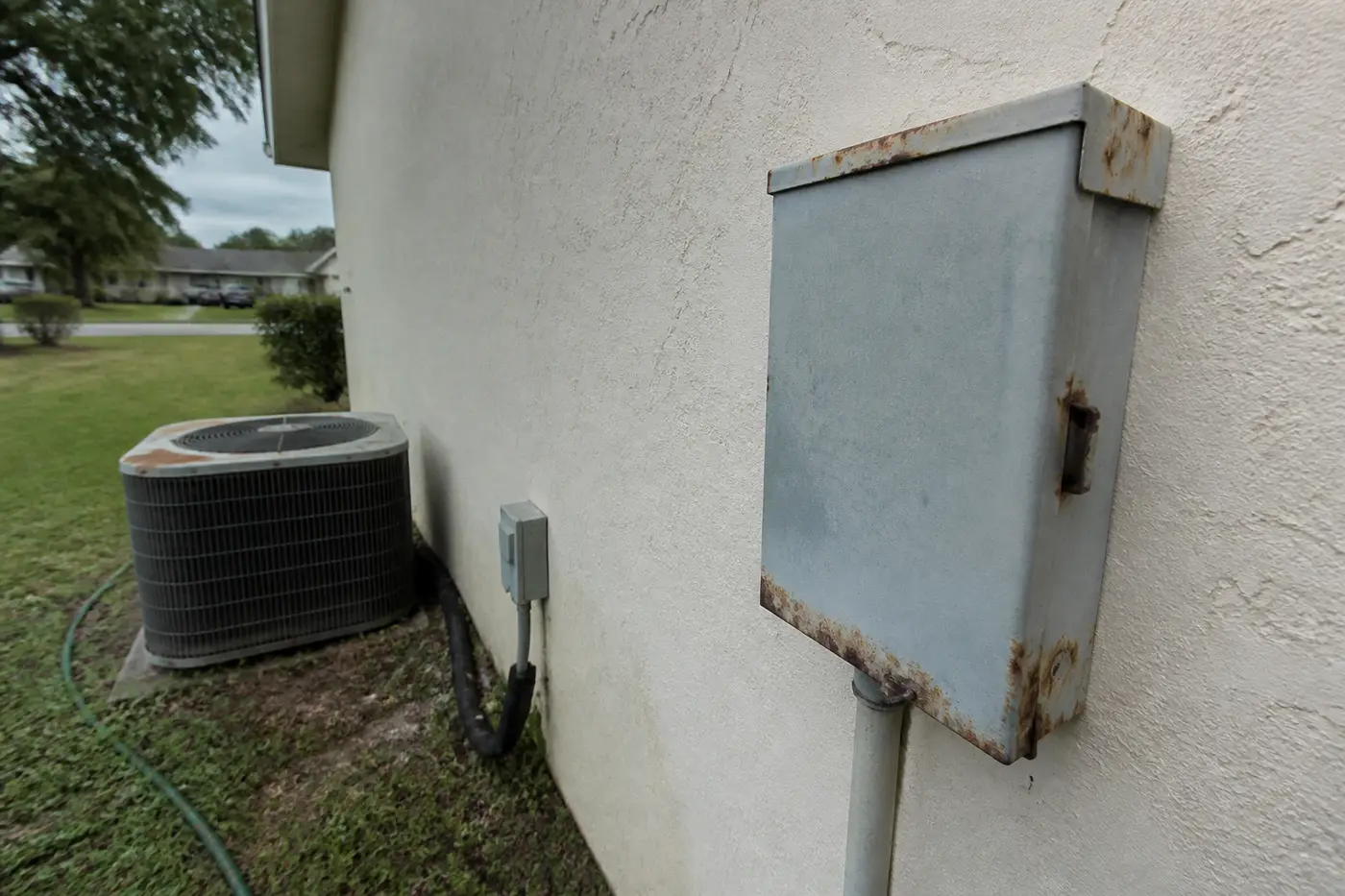
Salt does not care about SEER2. Within a few miles of tidal water, condenser fins pit, electrical lugs corrode, and outdoor fan motors take on rust from the inside. Coated coils and a hose rinse after a windy week buy time. Ignoring the outdoor unit does not.
Inland Wesley Chapel, Land O' Lakes, and most of New Tampa trade salt for pollen, grass clippings, and nine months of runtime. That is still harder than a national average, but it is a different failure pattern: dirty filters, packed condenser fins, and electrical parts cooked by cabinet heat above 140 degrees. Distance to the Gulf is why we change the maintenance cadence on the AC maintenance page instead of selling one schedule to every ZIP.
How often you should replace an AC in Florida
There is no birthday that forces a swap. Replace when the math says the next repair is buying one more summer, not when a salesperson quotes a round number. In practice, that conversation starts in earnest around year 12 on a Tampa Bay system, and it is already overdue on a lot of original 2001 to 2007 equipment in Seven Oaks, Meadow Pointe, Tampa Palms, and Hunter's Green.
Signs the unit is on its last legs, even if it still cools:
- Two major repairs in 24 months on a system past year 10.
- R-22 refrigerant still in the circuit. Production ended in 2020, so a leak is usually a replacement decision.
- The house hits temperature but stays clammy. Short cycling from an aging or oversized unit leaves humidity high.
- Power bills climbed with no change in how you live in the house.
- The compressor is the failed part and the rest of the system is the same age.
Running it every day is normal here
Yes, you can run the AC every day in Florida. From May through October, most Tampa Bay homes should. The mistake is running the fan on ON between cycles. That re-evaporates water off the coil and pushes it back into the rooms, which is why the house feels wet at 74 degrees. Leave the fan on AUTO. Set the thermostat in the mid-70s when you are home, a few degrees higher when the house is empty, and keep vents open. Closing bedrooms to "save money" is how coils freeze.
A system that runs 14 to 16 hours on a design day is doing the job it was sized for. A system that never shuts off and never reaches setpoint is a repair call, not proof that Florida AC is supposed to run forever.
A 40-year AC is not a Florida story
You will see that question under the search result. A window unit in a guest room, or a system that sat unused in a northern house, can limp a long time. A central system that has been cooling a Tampa Bay house since the 1980s is already a museum piece, and the refrigerant, the efficiency, and the failure risk are all wrong for 2026. If someone quotes 40 years as a selling point, they are not talking about this climate.
Repair vs replace once you pass year 10
We use the same rule we print on the invoice. Multiply the system's age in years by the repair cost. If the result is above $5,000, replacement usually wins on a five-year operating-cost basis. An 8-year-old unit needing a $220 capacitor is $1,760, so you repair it. A 13-year-old compressor at $2,400 is $31,200 on that score, so you replace. We show both numbers on the same page. The decision is yours.
A $180 to $320 capacitor on a 10-year-old Rheem is an easy yes. The same compressor job on that unit is usually a no, because the coil and fan motor are the same age and R-410A is on the way out. That is the conversation on an AC repair visit, not a bait-and-switch into a new system.
What a Tampa Bay replacement actually costs
A typical 3-ton 15.2 SEER2 changeout in this market runs about $7,500 to $10,500 installed, with 2-ton closer to $6,500 to $9,000 and 5-ton at $10,000 to $14,000. That is not an I Care Air Care quote. Those bands match Angi Tampa and This Old House figures we already cite on the HVAC replacement cost guide. Higher SEER2 tiers buy humidity control and quieter operation more than they buy a fast energy payback here.
The federal 25C credit that paid up to $2,000 toward a qualifying heat pump expired for equipment placed in service after December 31, 2025. A system installed this year does not get it. Duke Energy Florida's Home Energy Improvement program still advertises up to $1,000 on a qualifying single-family HVAC replacement, with a Home Energy Check required before the work. Confirm the current terms on Duke's page, and check which utility is on your bill. Synchrony 0% promotional financing is on our financing page for approved credit.
The best month to buy is March or April, for the same reason the best month to book a tune-up is March or April. Emergency volume has not peaked, crews can take a full day on a changeout, and you are not bidding against every no-cool house in July. That is logistics, not a holiday sale.
Tim's tip: ask for the commissioning numbers on the invoice: static pressure, temperature split, superheat, and subcool. A cheap install skips those because they take time. Those numbers are what decide whether you get 15 years or 10. If nobody will write them down, the discount is the most expensive part of the quote.
What actually adds years to the unit you have
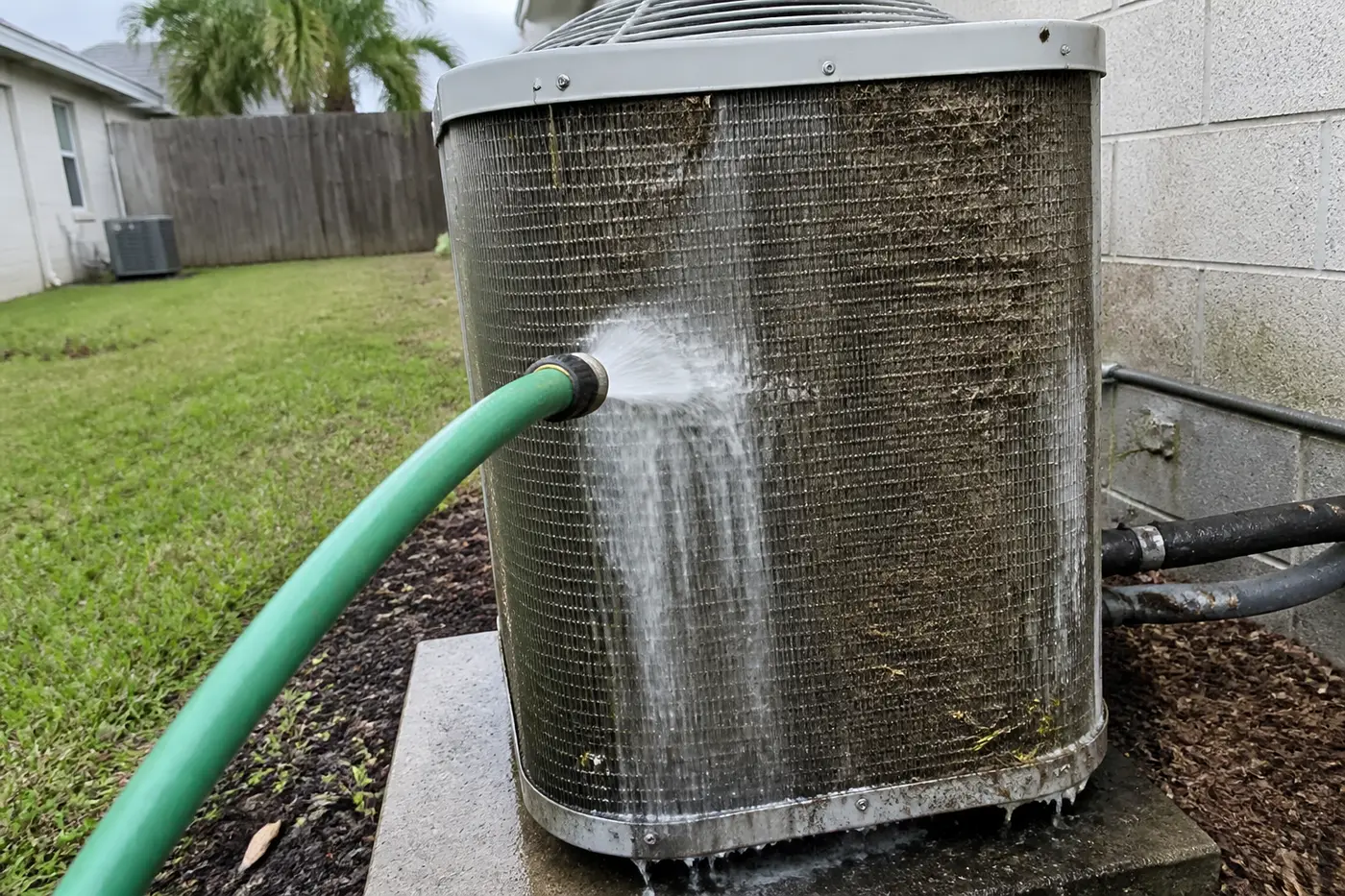
Change the 1-inch filter every 30 to 60 days in this climate, closer to 30 with pets or nearby construction. Rinse the outdoor coil from the top with a garden hose at household pressure, never a pressure washer. Keep 2 feet of clearance around the condenser, including the hedge that looked fine when it was planted. Book two professional visits a year, spring and fall, so a weak capacitor is a Tuesday part instead of a Saturday compressor.
If the system is already past year 12 and you are staring at a large repair, skip the folklore and get both numbers in writing. Call (813) 395-2324 or book from the HVAC installation page. We will tell you if the unit has another summer in it, and we will tell you if it does not.

Tim founded I Care Air Care in 2010 after 30+ years in the Tampa Bay HVAC trade. EPA Universal certified. The source for all technical guidance published on this site.
Read Tim's full profile →Related local help
These pages connect this guide to the services and local areas homeowners usually need next: