Quick Answer
Choose the right AC repair company Wesley Chapel this summer. See the key signs of a qualified, licensed, and safety-focused contractor.
Start here before you book service
- ✓ Ask for a current EPA Section 608 certification, which is legally required to handle any refrigerant.
- ✓ Confirm A2L-specific training for the new, mildly flammable R-454B and R-32 refrigerants.
- ✓ Request a certificate of insurance before any technician works on your property.
- ✓ Get a written, flat-rate quote up front to avoid summer surge upselling.
Sounds like you need a tech?
(813) 395-2324Your air conditioner will break on the hottest Saturday of the year. It's not a question of if, but when. And when it does, the company you call will determine whether you're comfortable again in hours or sweating in misery for days.
This summer, the stakes are higher. New, mildly flammable refrigerants are now the law, and the frantic peak season demand separates prepared professionals from dangerous amateurs.
Choosing the right AC repair company isn't just about price anymore, it's about safety, speed, and avoiding a costly mistake when you're most vulnerable. Keep reading to learn the non-negotiable checks that will protect your home and your comfort.
Key statistics on choosing an AC repair company
The data paints a clear picture of a perfect storm: unprecedented regulatory change colliding with extreme seasonal demand. For Florida homeowners, this means the wrong choice can lead to safety risks, long delays, and significant financial loss.
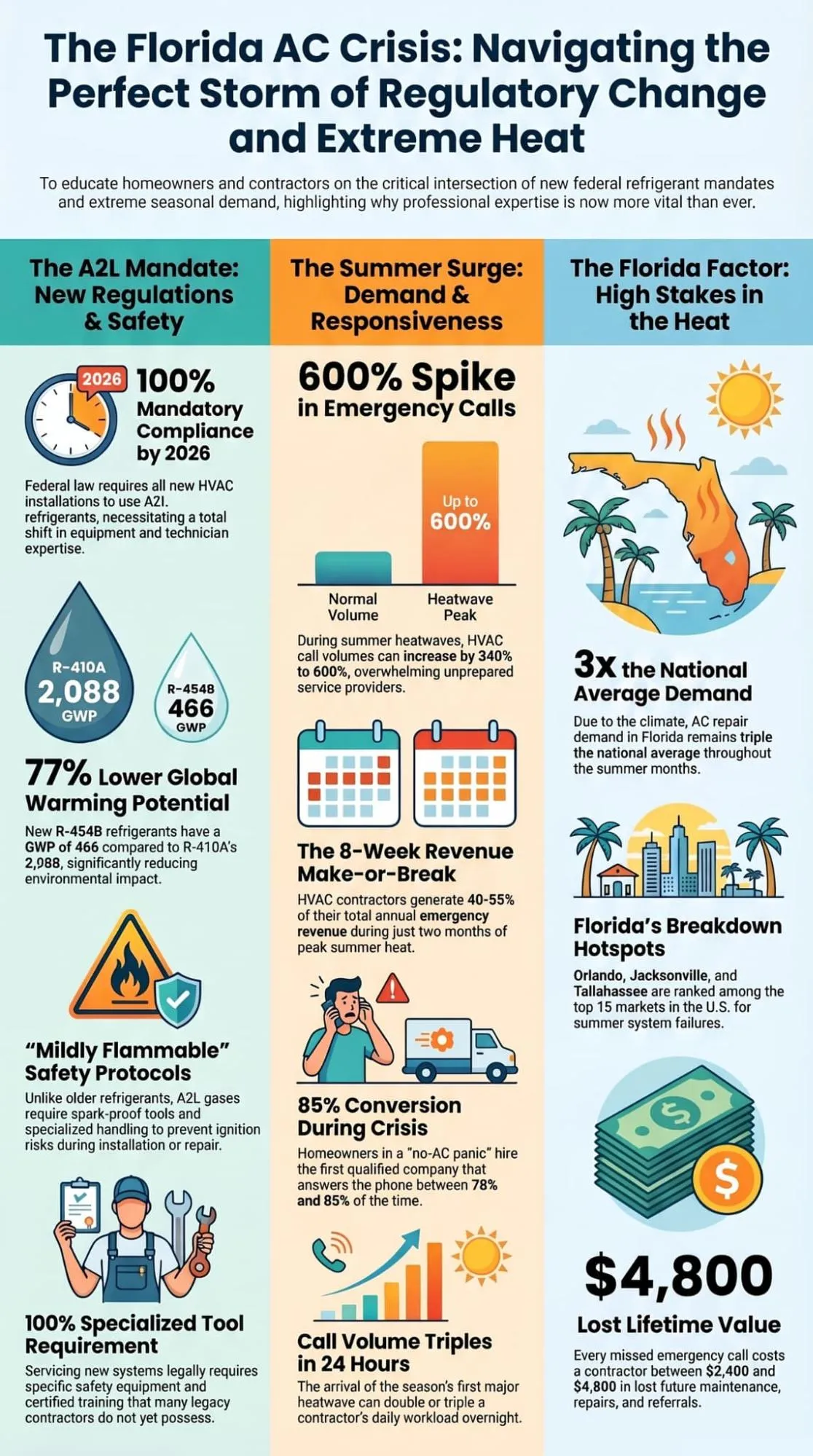
- 100% of new systems must be A2L-compatible by 2026 – Federal law mandates that all new HVAC installations use next-generation A2L refrigerants, requiring technicians to have specific, updated training.
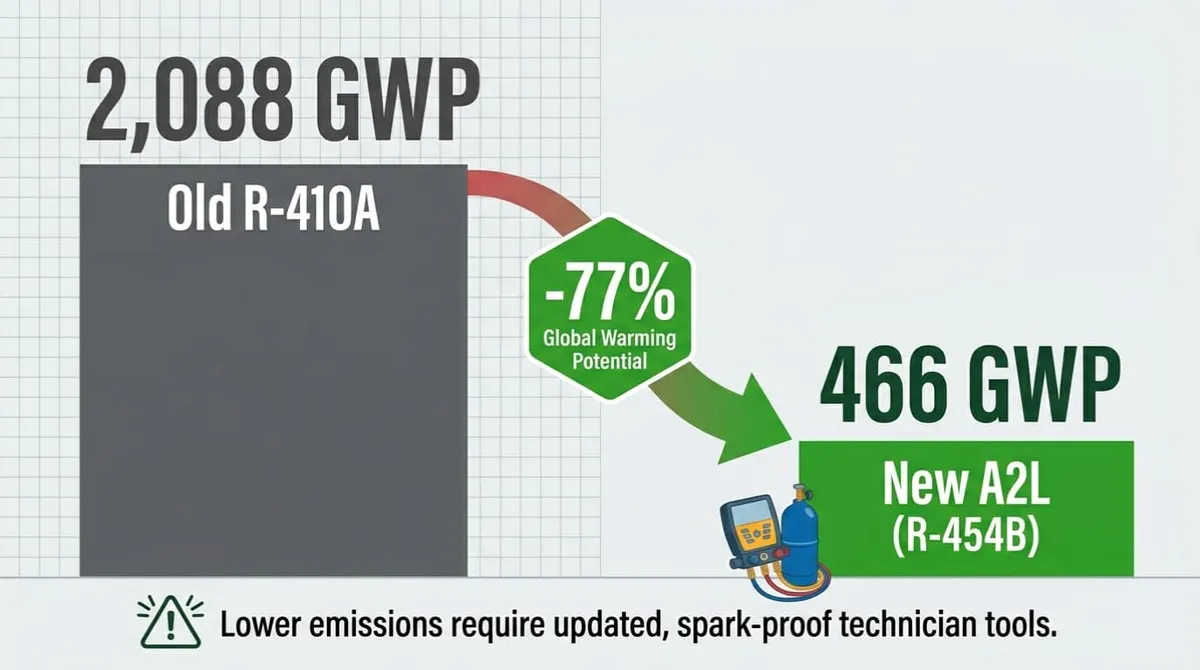
- R-410A GWP: 2,088 / R-454B GWP: 466 – The new refrigerants have a 77% lower Global Warming Potential, but their "mildly flammable" classification introduces critical new safety protocols for handling.
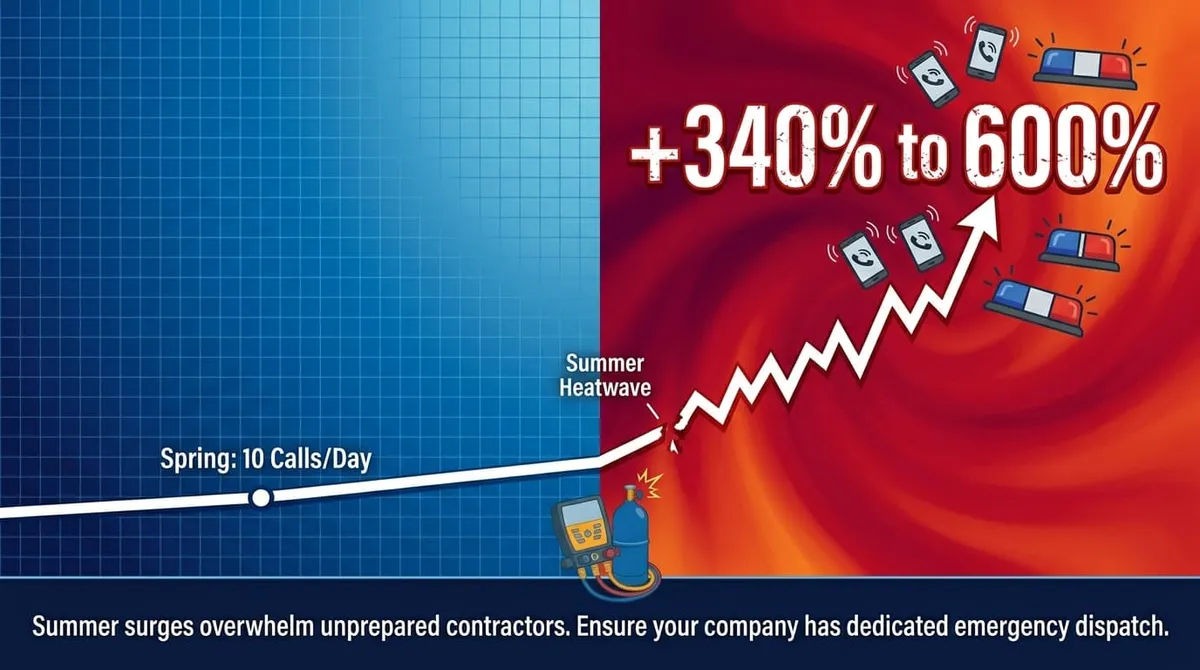
- 340% to 600% increase – HVAC emergency call volume can skyrocket by over 600% during a summer heatwave, overwhelming companies that aren't staffed or organized for the surge.
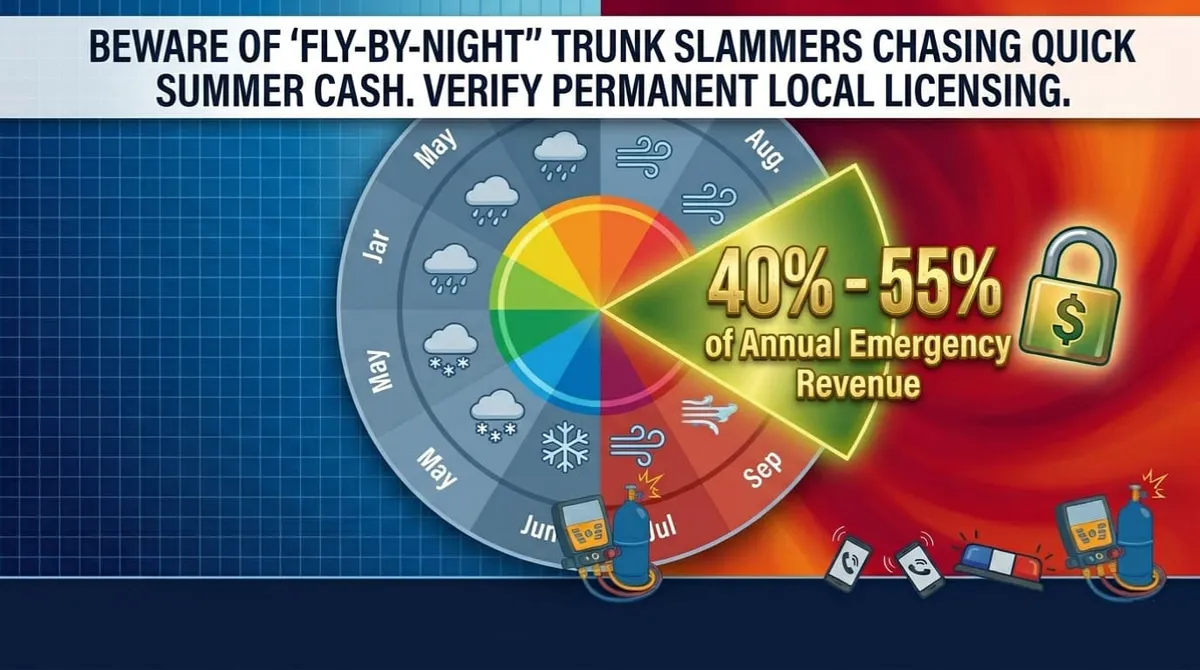
- 40-55% of annual emergency revenue – For contractors, nearly half of their yearly emergency service income is generated in just the 8-week summer peak, making responsiveness a make-or-break business metric.
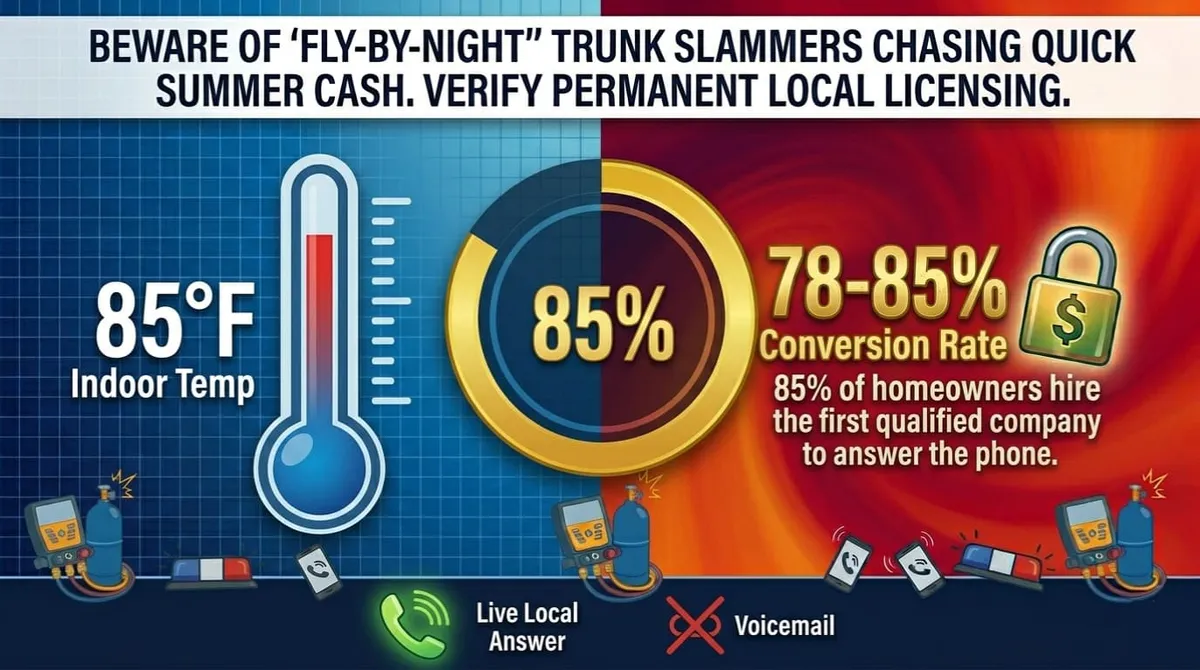
- 78-85% conversion rate – Homeowners in a panic from a broken AC are highly likely to hire the first qualified company that answers the phone and offers immediate help.
- $2,400 to $4,800 lost lifetime value per missed call – When a company misses an emergency call, they don't just lose the repair ticket; they sacrifice future maintenance contracts and referrals worth thousands.
- 3x the national average – AC repair demand in hot-weather states like Florida is three times higher than the national average during summer, creating intense competition for qualified technicians.
- 100% of new A2L handling requires specific safety tools and training – Servicing the new refrigerants isn't optional; it legally requires spark-proof tools and certified training to prevent ignition risks, which many older contractors lack.
- 3 of top 15 summer breakdown markets – Florida cities like Orlando, Jacksonville, and Tallahassee rank among the nation's worst for summer system failures, proving the statewide strain on HVAC services.
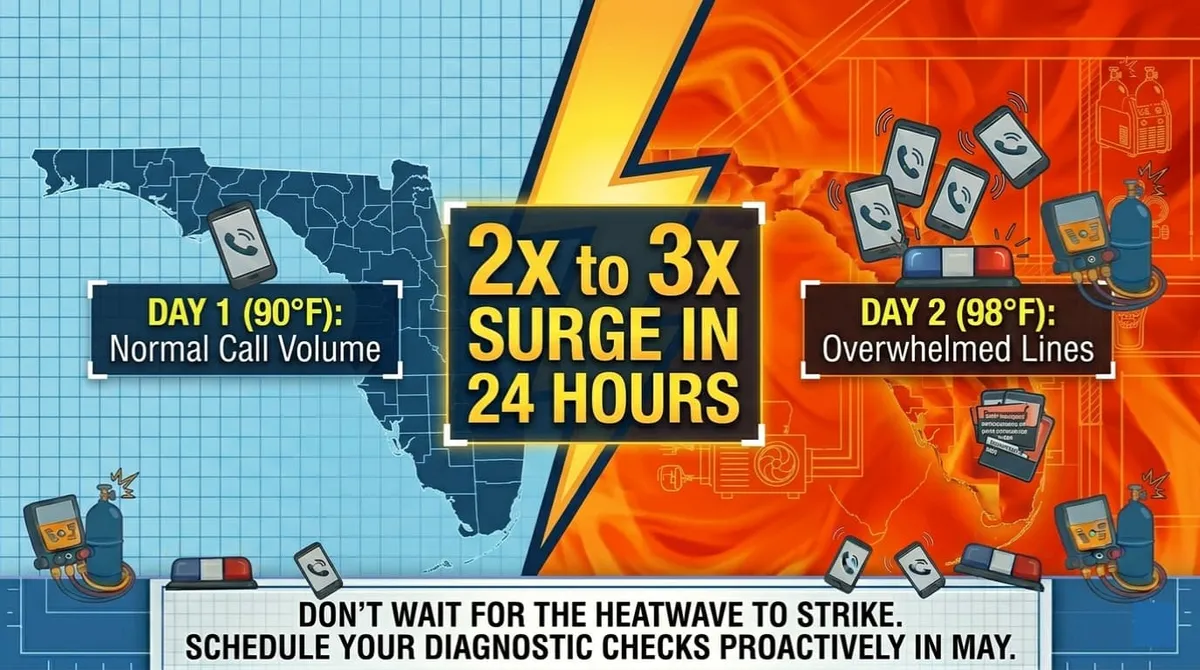
- 2x to 3x increase in 24 hours – The first major heat wave can double or triple a contractor's daily call volume overnight, instantly exposing which companies are prepared and which will leave you on hold.
100% of new systems must be A2L-compatible: the non-negotiable rule
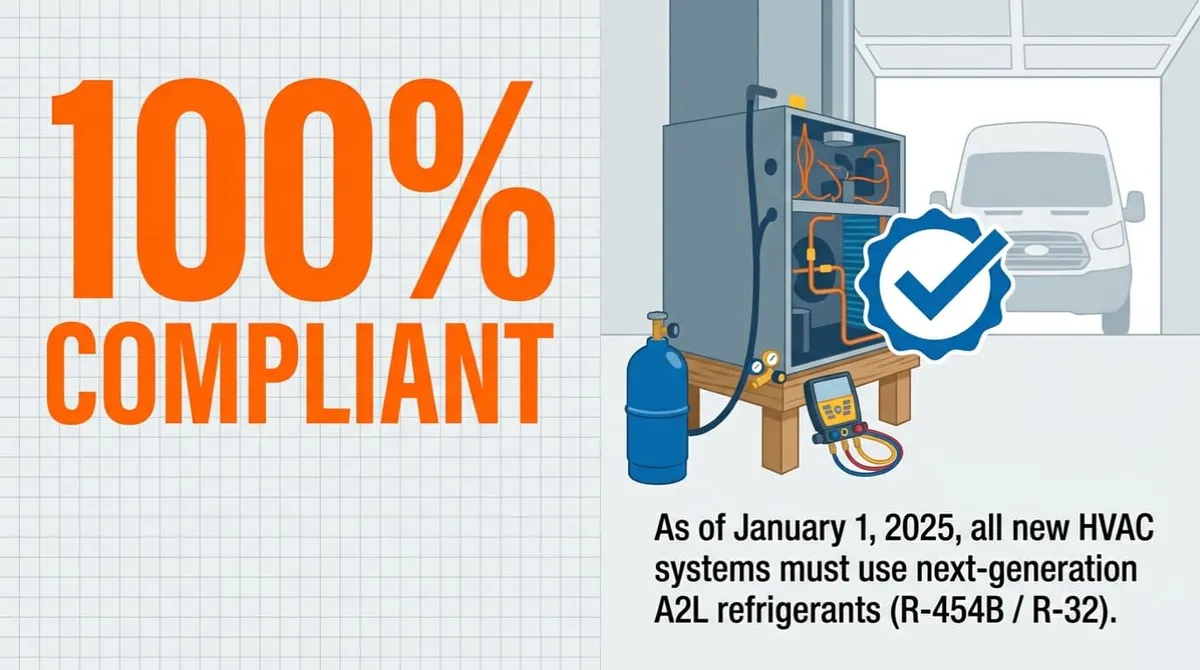
According to EPA AIM Act via ServiceAgent.ai, all newly installed residential and commercial HVAC systems must transition to next-generation A2L refrigerants, making compliance mandatory across the industry.
If a contractor installs a new central air system, heat pump, or ductless mini-split after January 1, 2025, it must use an A2L refrigerant like R-454B or R-32. The "100%" is absolute.
For you, this means any quote for a new system should explicitly state the refrigerant type. If a technician tries to sell you a new unit with old R-410A, they are either misinformed or attempting to clear illegal inventory.
More critically, their entire team must be trained to handle these new gases safely. Hiring a company not versed in A2Ls for a new installation isn't just unwise, it's potentially dangerous and non-compliant.
2,088 vs. 466 GWP: why the new refrigerants are here to stay
According to refrigerant transition data, R-410A has a Global Warming Potential (GWP) of 2,088, while R-454B reduces that figure to about 466. This 77% reduction is the entire point of the phase-out. But that lower number comes with a trade-off the industry calls "mildly flammable."
This doesn't mean your AC is a bomb. It means that during servicing, if refrigerant leaks near an ignition source, like an electrical spark from a standard tool, it could ignite.
The old ways of doing repairs are now unsafe:
- Using any metal tool
- Brazing lines without special purging
The new GWP number represents progress for the planet, but it demands progress in technician training and tools. A qualified company won't just have the new refrigerant; they'll have:
- Spark-proof recovery machines
- Leak detection tools rated for flammable gases
- Certified training to use them
340% to 600% increase: what a summer surge really feels like
According to HVAC industry emergency service data, contractor call volumes can surge between 340% and 600% during major summer heat waves, overwhelming companies that lack adequate staffing and dispatch capacity.
Imagine a typical Tuesday in May. Your HVAC company gets 10 service calls. Now imagine the first 95-degree Saturday in July. That call volume doesn't just double; it can explode to 50 or 60 calls by lunchtime.
A 600% increase isn't an abstract statistic. It's 50 people calling before you, all with the same urgent problem. This is why companies that are charming and prompt in the spring can become unreachable ghosts in July. They simply don't have the capacity to handle the surge.
When you're vetting a company, ask about their summer staffing plan. Look for specifics like:
- Extra certified technicians: Do they bring on additional, qualified staff for the peak season?
- Dedicated emergency dispatch: Do they have a separate phone line or system for urgent summer calls?
- Extended hours: Do they offer weekend or evening appointments during peak months?
Their answer will tell you if they've planned for the reality of the Florida summer, or if they'll leave you stranded in the heat. If you are already without cooling, our emergency AC repair team dispatches from Wesley Chapel and gives you a realistic arrival window before we hang up.
40-55% of annual emergency revenue: why summer defines HVAC companies
According to HVAC business research, the summer peak isn't just a busy season, it's a survival season. Generating up to 55% of their annual emergency income in 8 weeks creates immense pressure. This concentration of revenue does two things.
First, it incentivizes serious companies to be exceptionally prepared, they have to be to capture that crucial income.
Second, it attracts "fly-by-night" operators who see a chance to make quick money without the overhead of year-round training and licensing.
A company that pops up in June might just be trying to grab a slice before fading away in September, often without the proper credentials to do the job safely.
78-85% conversion rate: the psychology of a panicked homeowner
According to HVAC business research, homeowners experiencing an unexpected AC failure are highly likely to hire the first qualified company that answers the phone and can respond quickly.
When your home hits 85 degrees at 4 PM on a Sunday, your decision-making process changes. You're not comparing three detailed estimates.
You're calling companies from a Google search until someone answers. The one that picks up the phone, expresses empathy, and says "a technician can be there in two hours" has an 85% chance of getting the job.
This statistic reveals a critical truth: during a breakdown, availability is a primary qualification. A company with flawless credentials is useless if you can't reach them.
This is why the top local companies invest in live, local answer services, not just voicemail, during peak season. They know that the moment of crisis is when you choose a partner, often for life.
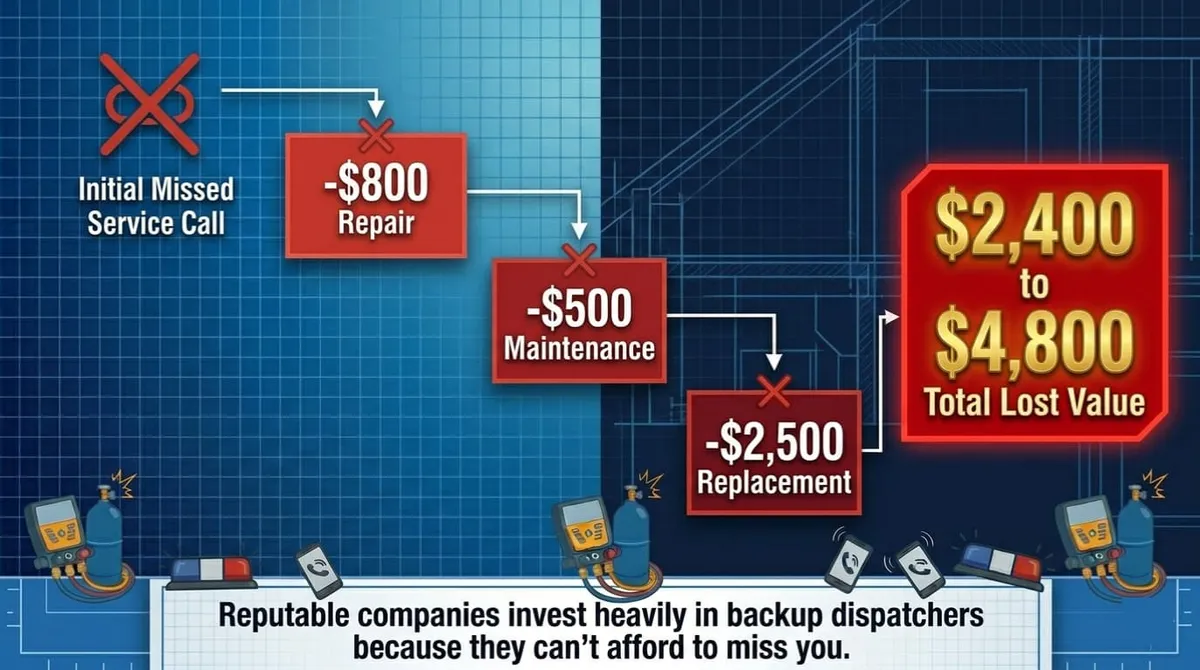
$2,400 to $4,800 lost: the true cost of a missed call
According to HVAC business research, a missed emergency service call can cost an HVAC company thousands of dollars in future maintenance agreements, replacement projects, and referral opportunities.
This figure is a stark business lesson that directly benefits you, the homeowner. It calculates that a missed $800 repair call also loses a $500 annual maintenance plan, a water heater replacement next year, and the referrals from that homeowner to 1.4 neighbors.
For a reputable company, that's a $4,800 mistake. Therefore, companies that understand this math are fanatical about answering calls. They have backup dispatchers, they route after-hours calls to managers' phones, they do whatever it takes.
When you call a company and get a live person who is calm and helpful during a heatwave, you're not just lucky. You've likely found a company that values your long-term business enough to have invested heavily in being available. That's a strong indicator of overall professionalism and reliability.
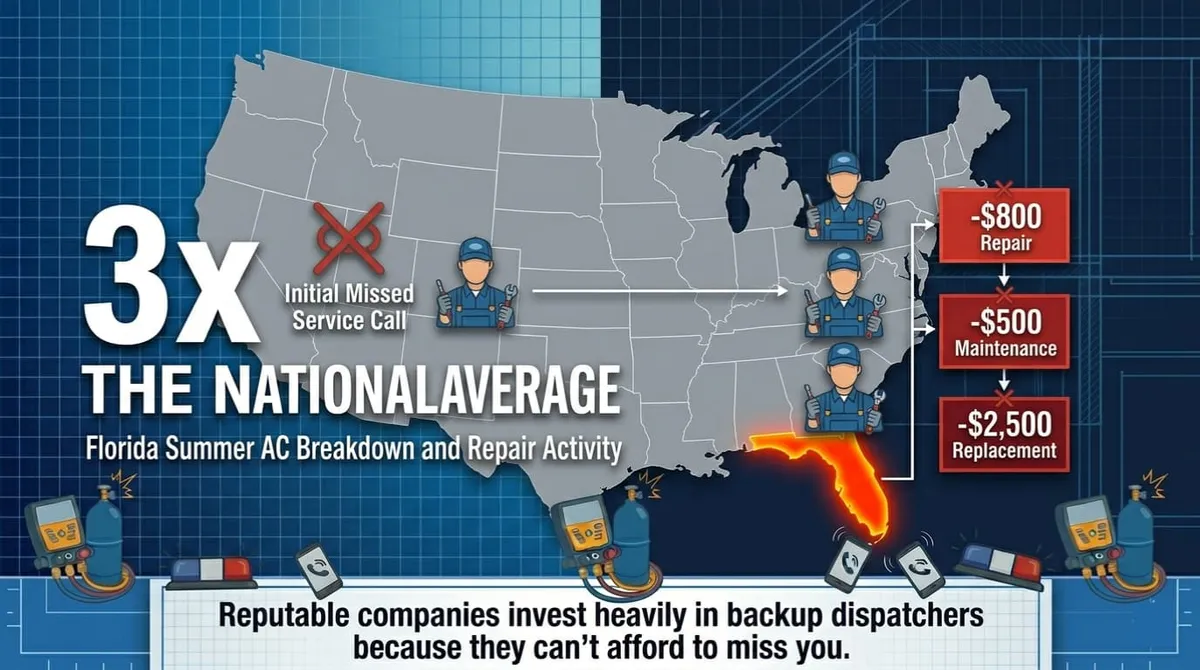
3x the national average: Florida's unique AC repair burden
According to regional HVAC demand analysis, repair activity in hot-weather states such as Florida can reach three times the national average during peak summer months.
Florida's cooling season isn't a season, it's most of the year. Systems here run harder, longer, and against a brutal adversary: humidity. This constant strain leads to more frequent breakdowns. The "3x" higher demand means that for every technician available in a temperate state, Florida needs three to handle the same population.
This scarcity drives up labor costs and wait times. It also means that the licensed, skilled technicians are in extremely high demand. They can pick and choose where they work. They gravitate toward companies that invest in them with training, good equipment, and fair pay.
The bargain-basement contractor offering a $49 tune-up is likely using unlicensed, inexperienced labor because that's all they can attract in this hyper-competitive market. You get what you pay for, and in Florida, paying for expertise is a summer necessity. Staying ahead of breakdowns with routine AC maintenance is the cheapest insurance against a peak-season emergency.
100% of A2L handling requires specific safety tools and training
According to EPA AIM Act via ServiceAgent.ai, technicians servicing these next-generation refrigerants must use specialized equipment, updated procedures, and manufacturer-approved training protocols.
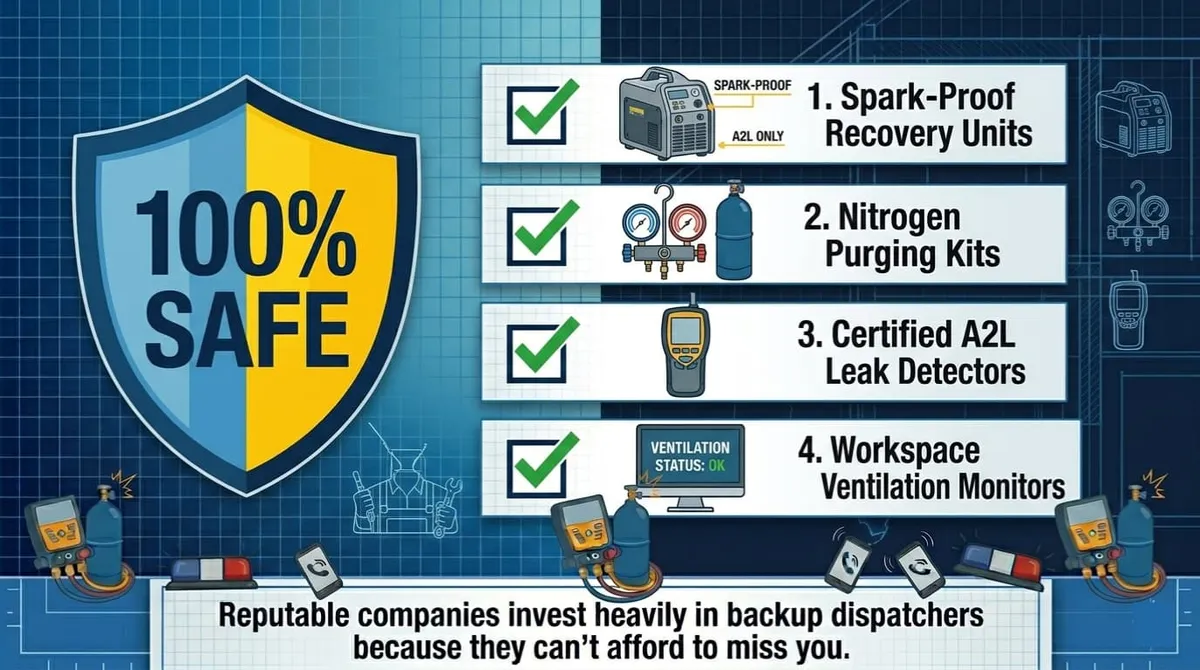
The "100%" here is about eliminating risk. You cannot safely recover, recharge, or leak-test an A2L system with the tools used for the last 20 years on R-410A. Standard recovery machines have internal electrical contacts that can spark. Standard torches can ignite a leak. The new protocols require:
- Spark-proof tools: Every piece of equipment that touches the refrigerant circuit must be rated for flammable gases.
- Purge procedures: Before brazing, the lines must be purged with nitrogen to prevent combustion inside the copper.
- Leak detection: Electronic leak detectors must be specifically calibrated for A2Ls.
- Ventilation: Technicians must monitor and ensure workspace ventilation during service.
An untrained technician with old tools is a legitimate safety hazard in your home. Asking "Are your tools and training updated for A2L refrigerants?" is not a technicality, it's a safety screening question.
| Qualification check | Why it matters in 2026 | Red flag to watch for |
|---|---|---|
| EPA Section 608 certification | Legally required to handle any refrigerant. | Technicians cannot produce a current card. |
| A2L-specific training | Required for safe handling of new, mildly flammable refrigerants. | The company is vague or says "it's basically the same." |
| Proof of insurance | Protects you from liability if a technician is injured on your property. | Hesitation to provide a certificate of insurance. |
| Local, verifiable reviews | Indicates consistent community presence and service quality. | Only reviews on their own website, no Google or BBB profile. |
| Written, flat-rate quotes | Prevents surprise charges and upselling during the emergency. | Only provides vague verbal estimates over the phone. |
3 of top 15 summer breakdown markets: Florida's statewide crisis
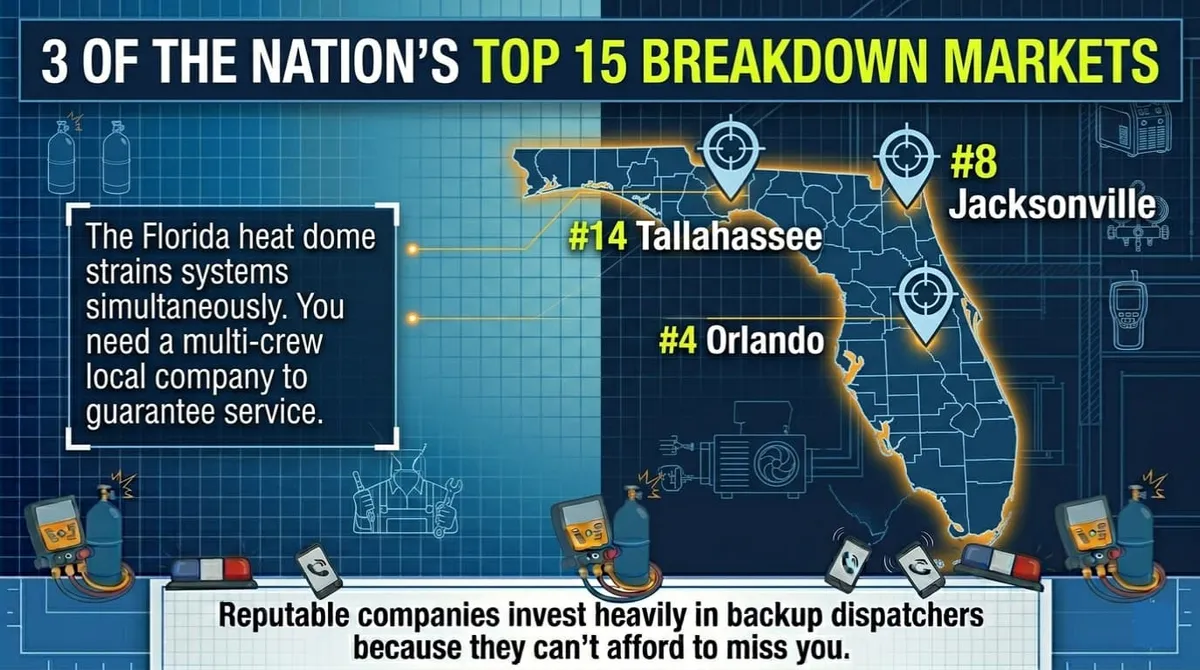
According to regional HVAC demand analysis, multiple Florida cities consistently appear among the country's most severe markets for air-conditioning failures during periods of extreme heat. The list includes:
- Orlando (#4)
- Jacksonville (#8)
- Tallahassee (#14)
This isn't about a few unlucky homeowners. It's a systemic, statewide event. When the Pep Boys Index tracks car AC failures, it's a direct proxy for environmental stress; the same heat and humidity that kill car ACs also push home systems past their limits.
For you in Wesley Chapel, this means when the heat dome settles over Florida, your neighbors in Seven Oaks, your family in Zephyrhills, and entire subdivisions across Tampa Bay are all calling for help at the same time.
The companies serving these top-15 markets have to be built for this scale. A one-truck handyman cannot cope. You need a company with:
- Multiple crews
- A coordinated dispatch system
- Deep local knowledge to navigate the simultaneous crises
2x to 3x increase in 24 hours: the heat wave lightning strike
According to HVAC industry emergency service data, the arrival of a major heat wave can double or even triple service call volume within a single day, placing immediate strain on local contractors.
This statistic explains why you can't wait. The breakdown spike isn't gradual. One day it's 92 degrees and manageable. The next day it's 98 with a heat index of 110, and by 10 AM, the phone lines are swamped. This overnight doubling is what separates the prepared from the overwhelmed.
A prepared company has on-call schedules, pre-stocked trucks, and a process for triaging true emergencies. An overwhelmed company stops answering the phone, their voicemail fills up, and their existing appointments get pushed back for days.
If you suspect your 12-year-old AC is struggling, calling for a diagnostic check in May is a strategic move. Waiting for the failure during the first heat wave means you are now part of that 300% surge, competing with everyone else for a shrinking pool of available time slots.
Stay prepared before the next Florida heat wave
When temperatures rise, the last thing any homeowner wants is an AC emergency. With new refrigerant regulations and increasing demand for qualified technicians, choosing the right HVAC partner before a breakdown happens is one of the smartest decisions you can make. A little preparation today can help you avoid costly repairs, safety concerns, and uncomfortable days without cooling.
For trusted service, expert guidance, and year-round peace of mind, connect with the team at I Care Air Care. We can help you stay comfortable, prepared, and ready for whatever the Florida summer brings. Call (813) 395-2324 or schedule AC repair in Wesley Chapel and Tampa today.
.webp "Tim Hawk, Owner of I Care Air Care")
Tim founded I Care Air Care in 2010 after 30+ years in the Tampa Bay HVAC trade. EPA Universal certified. The source for all technical guidance published on this site.
Read Tim's full profile →Related local help
These pages connect this guide to the services and local areas homeowners usually need next: