
.webp "Tim Hawk, Owner - I Care Air Care")
How Tampa heat pumps actually fail
Heat pump repair in Tampa is a different job than a Midwest heating call. A Wesley Chapel heat pump logs more runtime in a single July than a Minneapolis furnace logs in an entire winter. That duty cycle makes the failures here specific and predictable. Over the last twelve months our trucks diagnosed roughly 400 heat pump calls across Pasco, Hillsborough, and Polk counties, and five failure modes account for most of them:
- Run capacitor - about 35% of calls
- Contactor burnout - about 18%
- Reversing valve - about 12%
- Defrost control board - about 10%
- Refrigerant leak - about 9%
If you are still choosing between a heat pump and a straight AC, our guide on heat pump vs. AC in Tampa breaks down the trade-offs. Below is what each failure looks like and what it costs.
- 4.9★ · 700+ Google reviews
- Licensed · CAC1816515
- EPA 608 Universal Certified
- 16 years serving Tampa Bay
- 4,000+ homes served
- 1-year workmanship warranty
1. Failed run capacitor (about 35% of calls)
The run capacitor gives the compressor and outdoor fan the kick to start, then holds them at the right phase angle. Florida heat kills capacitors faster than any other part. Watch for:
- Outdoor fan dead while the indoor blower still runs
- Compressor humming but not starting
- The whole outdoor unit silent on a cooling call
Diagnosis takes about 10 minutes with a meter, and repair runs $180 to $320. It is the same part that fails most often on straight cooling systems, which is why it shows up across our AC repair calls too.
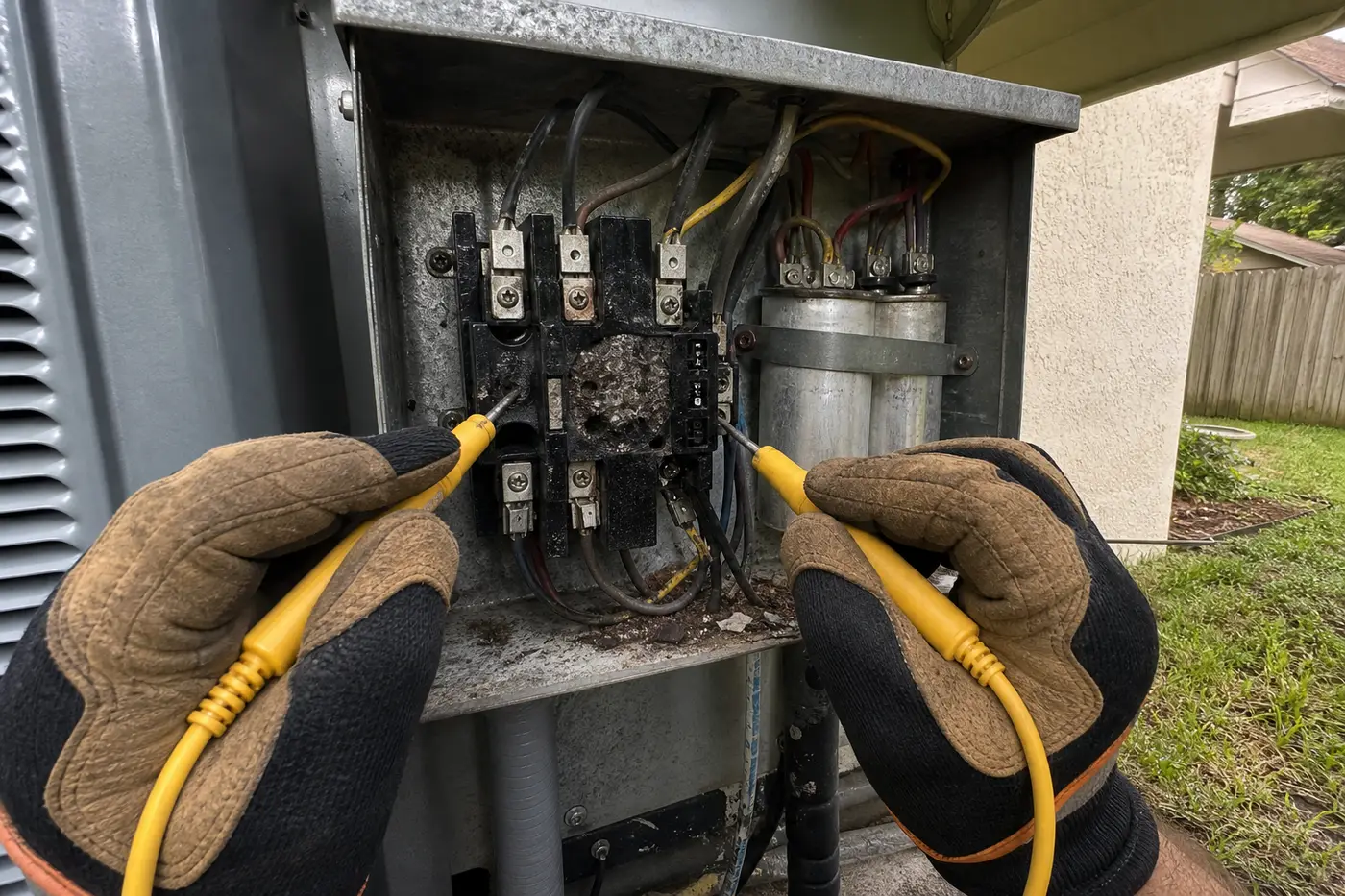
2. Contactor burnout (about 18% of calls)
The contactor is the relay that sends 240V to the compressor and fan. Years of micro-arcing pit the contacts until they fail one of two ways:
- Welded shut: the system runs even after you turn the thermostat off, and can destroy a compressor in about 72 hours.
- Failed open: nothing starts at all.
The welded-shut version is the dangerous one and often turns into an after-hours emergency repair if ignored. Repair is $180 to $350.
3. Reversing valve failure (about 12% of calls)
This is the part that makes a heat pump a heat pump, switching refrigerant flow between cooling and heating. It fails two ways:
- Pilot solenoid fails - usually a same-day fix at $220 to $380.
- Valve body sticks internally - a bigger job at $1,400 to $2,200, because the refrigerant must be recovered, the valve cut out and brazed in, vacuum pulled, and charge weighed back.
Symptoms: blows cold on heat mode, blows warm on cool mode, or gets stuck in defrost.
“My AC compressor failed twice and the team made a hard situation easy. They responded promptly, explained the issue, and even provided a temporary unit while we waited. I never felt like just another service call.”
4. Defrost control board failure (about 10% of calls)
Tampa Bay sees only 20 to 45 hours a year of freezing conditions, but that is enough to ice an outdoor coil. The defrost board runs a short reverse-cycle to melt that ice; when it fails, the coil freezes solid and the system shuts off on safety. The tell:
- Heat pump works fine above 50 degrees
- Stops working the morning after a cold January night
- Visible ice covering the outdoor coil
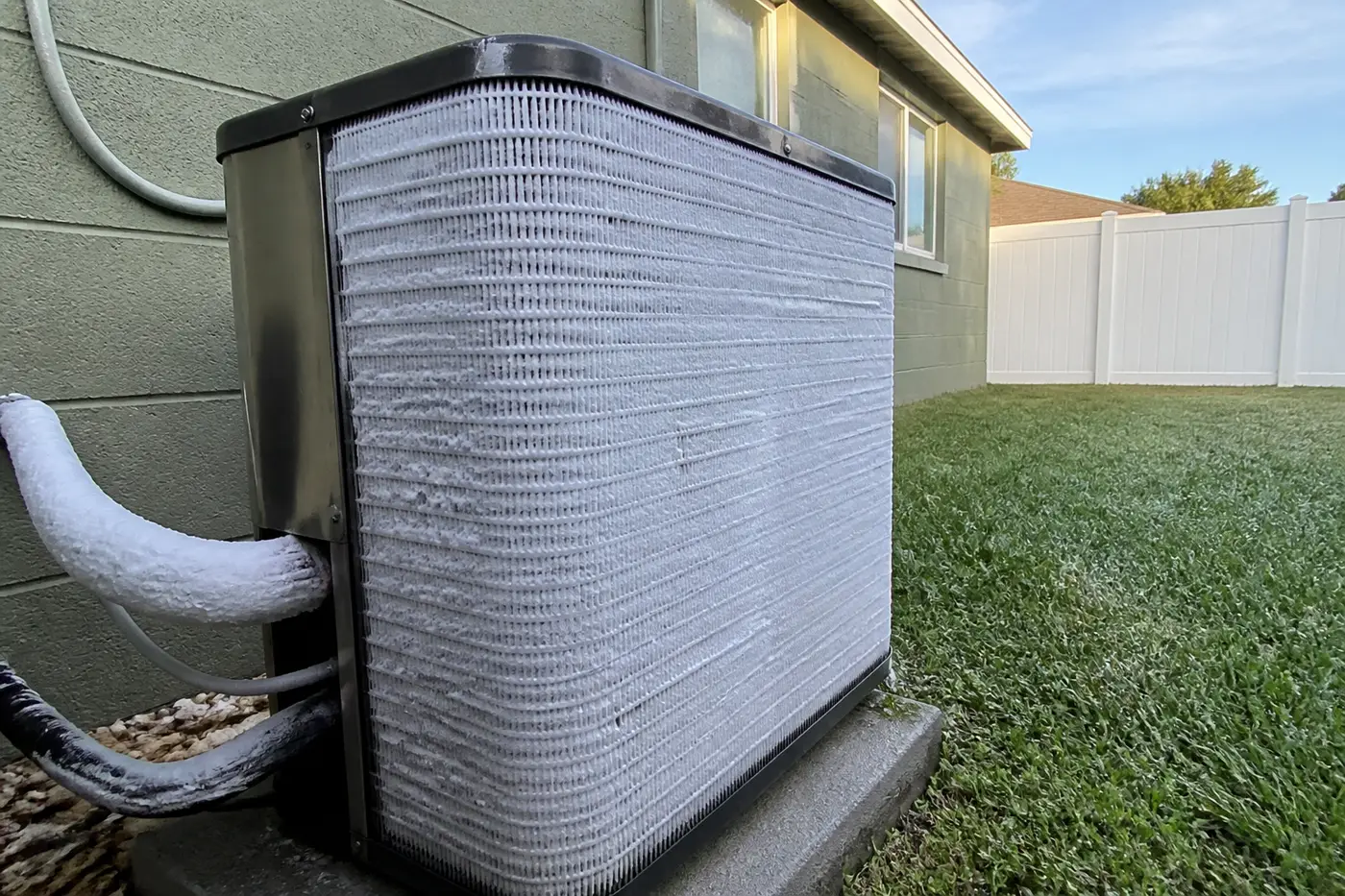
This is where heat pump repair overlaps with our broader heating services, since the heat pump is the heating system for most Florida homes. Repair runs $350 to $600 by brand.
5. Refrigerant leak (about 9% of calls)
Refrigerant is not "used up" in normal operation, so if the system is low, there is a leak. Common Florida leak points:
- The outdoor coil, where salt-air pitting accelerates corrosion near the Gulf
- The indoor evaporator coil, from formicary corrosion common in newer homes
- The flare fittings on mini-split line sets
We find leaks with electronic detectors, UV dye, or nitrogen pressure testing. Find-and-repair runs $450 to $1,200, more on an inaccessible indoor coil.
Heat pump blowing warm or stuck in defrost?
Describe what it is doing and we will tell you whether it is a same-day solenoid fix or something deeper. Straight answer, upfront pricing.
When to shut the system down immediately
Two symptoms mean stop running it and call, because pushing through turns a small repair into a compressor replacement:
- Ice on the copper suction line (the larger line at the outdoor unit). Running it slugs liquid refrigerant back to the compressor.
- A breaker that trips and immediately re-trips. Something downstream is shorted, and forcing a reset can fry the control board or compressor winding.
When either happens after hours, treat it as an emergency and call right away.
What a proper heat pump diagnostic covers
A real diagnostic is not a 15-minute guess. Ours includes, at minimum:
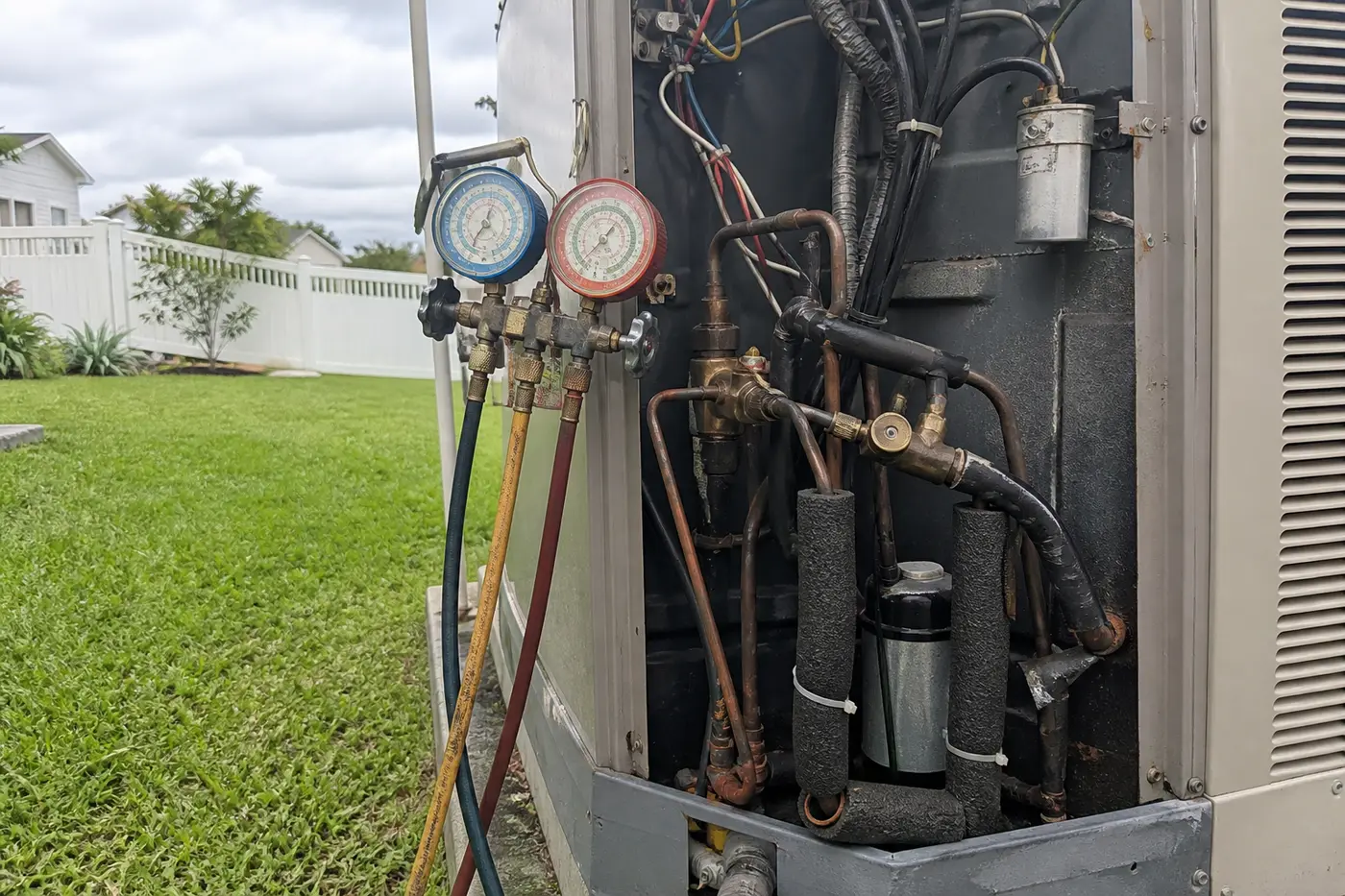
- Dual-port gauge reading of high-side and low-side pressure
- Superheat and subcool calculation
- Amp-draw measurement on compressor and fan
- Capacitor test under load, not just a static meter read
- Contactor inspection and refrigerant leak check where indicated
- A written summary of findings with repair options and pricing
If a tech calls a compressor dead in 15 minutes with no pressure readings on paper, get a second opinion. That same thoroughness on a regular maintenance visit is what keeps systems off our repair schedule to begin with.
Heat pump repair pricing you can count on
These are our 2026 Tampa Bay flat-rate ranges. The actual number depends on brand, access, and part availability, but we quote upfront before turning a wrench:
- Run capacitor replacement: $180 to $320
- Contactor replacement: $180 to $350
- Defrost control board: $350 to $600
- Reversing valve solenoid: $220 to $380
- TXV replacement: $450 to $750
- Condenser fan motor: $450 to $850
- Full reversing valve swap: $1,400 to $2,200
- Refrigerant leak repair and recharge: $450 to $1,200
- Compressor replacement (out of warranty): $2,200 to $3,800
Every repair carries a 1-year parts-and-labor warranty, and the bigger jobs qualify for 0% financing so you can fix it now and pay over time.
A surprise repair should not wreck your budget
Qualified homeowners can spread repairs and replacements into low monthly payments with 0% financing through Synchrony. Apply in minutes and decide with zero pressure.

How to make a Florida heat pump last longer
Tampa Bay runtime is brutal on equipment, but a few habits add years before you face a replacement:
- Change the filter every 1 to 2 months during cooling season, a clogged filter starves the coil and overworks the compressor.
- Keep the outdoor unit clear of grass clippings, mulch, and shrubs by at least two feet for proper airflow.
- Rinse the coil gently with a garden hose a few times a year, especially closer to the Gulf where salt accelerates corrosion.
- Book two tune-ups a year so worn capacitors and low charge get caught early on a maintenance visit.
- Do not ignore small symptoms, a faint hiss or a slightly higher bill is cheaper to fix today than after a compressor starves.
Repair vs. replace: honest math
When a repair quote lands above $1,500 on a system past year 10, pause and run the replacement math. The rule we use on Tampa Bay heat pumps:
- Repair when the cost is under 35% of a like-for-like replacement, or the system is under 10 years old.
- Replace when the repair exceeds 35% of replacement AND the unit is over 10 years old, since the coil, fan motor, and aging R-410A are all near end of life.
We show both numbers on the same invoice so you decide. If replacement wins, our HVAC installation and AC replacement pages cover new high-efficiency systems, our SEER2 guide explains the efficiency savings, and our Carrier vs. Trane vs. Rheem comparison helps you pick a brand.
Heat pump acting up? Call Tim and the team at (813) 395-2324 or book a diagnostic online. We dispatch from Foamflower Blvd and give you a straight arrival window before we head out.
October in Wesley Chapel is still a cooling month
Tampa International's 1991 to 2020 normals put October at a high of 85.6°F and a low of 69.2°F. The month has about 388 cooling degree days and 3 heating degree days. November is the turn: a high of 78.9°F, a low of 60.7°F, 178 cooling degree days, and 34 heating degree days. December is the first month where heating degree days (105) edge past cooling degree days (102), with a high of 73.9°F and a low of 55.9°F. Those figures are the Florida Climate Center normals for the Tampa station. Wesley Chapel nights run a little cooler than the airport. That part is an inference from inland Pasco, not a separate station file.
A homeowner who sets the thermostat to heat on a 60-degree morning and gets cool air needs the reversing valve, the outdoor sensor, and the heat strips checked. That visit uses gauges and a written temperature split, the same standard as a July no-cool call. The filter and the drain still decide whether the system can move air when the mode changes. Homes in Seven Oaks, Meadow Pointe, and along Curley Road see this every fall. The work is a diagnosis, written down, for a house in Pasco or north Hillsborough.