
Quick Answer
Ice on your AC coil? Shut the system off, set the fan to ON, and read the five causes, the real thaw times, and what a Tampa Bay repair costs.
Start here before you book service
- ✓ Set the thermostat to OFF and the fan switch to ON. That stops the freezing and starts the thawing.
- ✓ Pull the air filter. A clogged filter is behind most frozen coils we see in Pasco County.
- ✓ Put towels under the air handler. Melting ice can overflow the drain pan.
- ✓ Never chip, scrape, or pry at the ice. You will puncture the coil.
- ✓ If it freezes again within a week of thawing, the cause is refrigerant or airflow and needs a licensed tech.
Sounds like you need a tech?
(813) 395-2324Shut the system off now, then set the fan to ON
Move the thermostat from COOL to OFF. Then move the fan switch from AUTO to ON. That pair of settings stops the refrigerant circuit from making more ice while the blower keeps pushing room-temperature air across the coil, which melts what has already built up. Do it before you read anything else on this page.
Two things go wrong if you keep running a frozen system. Ice is an insulator, so the coil cannot absorb heat and your vents blow warm air no matter how low you set the thermostat. More seriously, refrigerant that should have boiled off inside the coil comes back to the compressor as liquid. A compressor is built to pump vapor, and liquid floodback is one of the few failures that can turn a $300 service call into a compressor replacement or a whole new system.
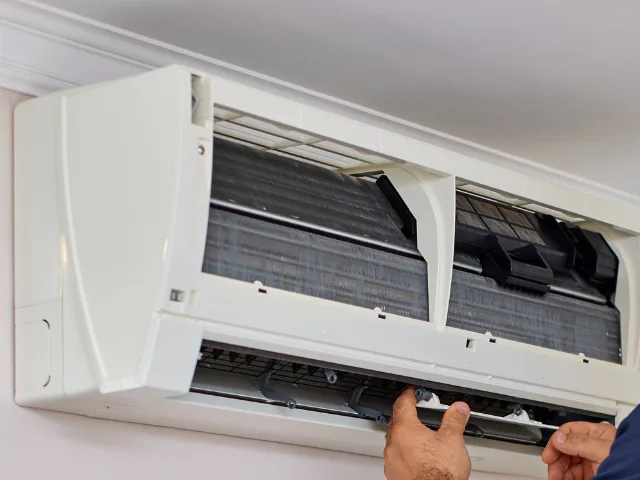
While the ice melts, do three things. Pull the air filter and hold it up to a light. Put old towels down under the air handler, because a fully iced coil holds a surprising amount of water and the drain pan was never sized for all of it arriving at once. And keep your hands off the ice. Homeowners who go after it with a screwdriver or a hair dryer routinely puncture the thin aluminum fins or the copper tubing behind them, which converts a cleanable problem into a coil replacement.
Tim's tip: before you turn the system back on, take a photo of the coil and the copper lines with your phone. If it freezes a second time, that photo tells us where the ice started, and ice at the suction line near the service valve points somewhere very different than ice spread evenly across the whole coil face. It saves us fifteen minutes of diagnosis on your dime.
Ice on the line set and warm air at the vents mean a frozen coil
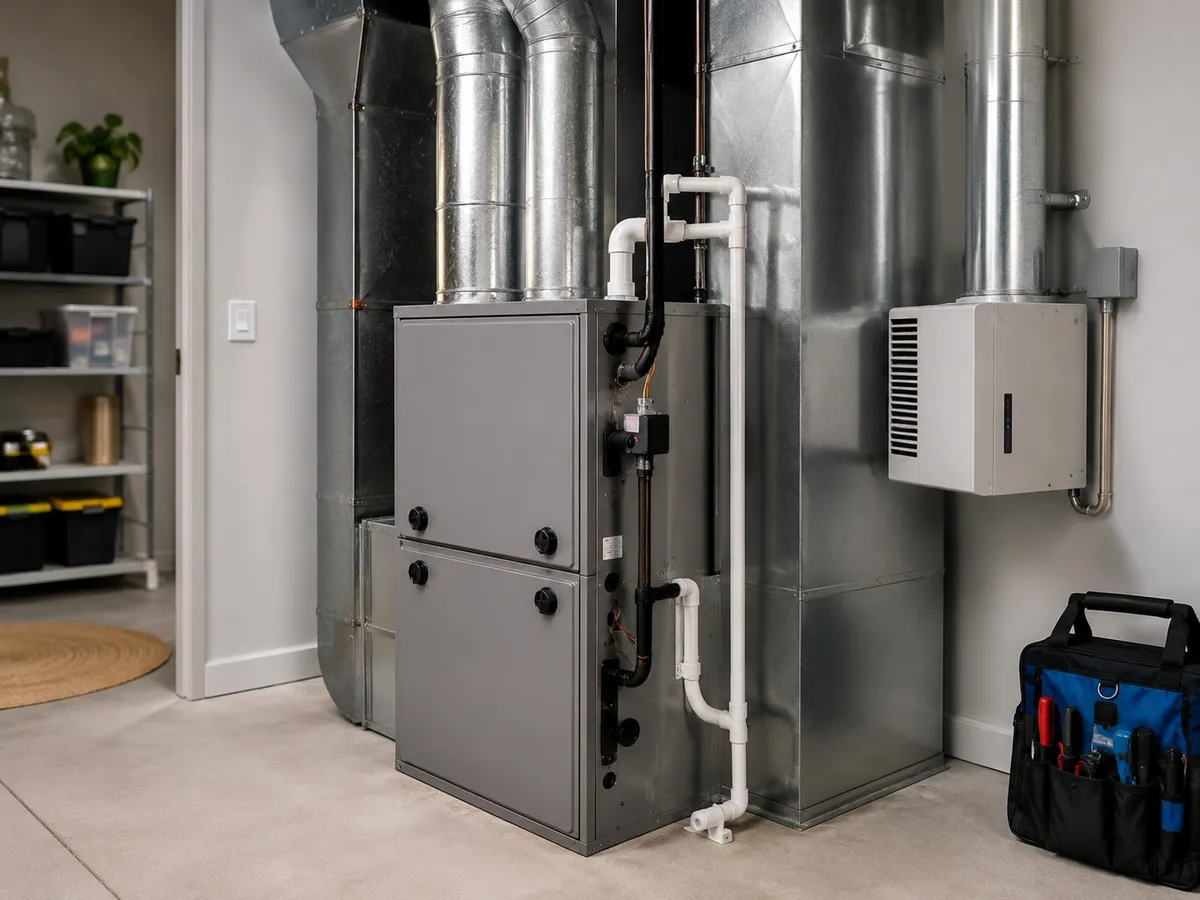
The evaporator coil sits inside your air handler, which in most Wesley Chapel and Land O' Lakes homes lives in the garage, a closet, or the attic. You usually cannot see the coil itself without pulling a panel, so you diagnose it from the outside.
- Frost or ice on the copper line. Two copper lines run between the air handler and the outdoor condenser. The larger, insulated one is the suction line. If it is white with frost or wearing a sleeve of ice where it enters the cabinet, the coil is frozen.
- Warm or barely cool air at the vents while the system runs. Air is moving, the outdoor unit is humming, and the house keeps climbing anyway.
- Weak airflow. Ice physically blocks the passages between the fins, so the blower is trying to push air through a wall.
- Water on the floor or a tripped float switch. The condensate system handles a steady drip, not a thaw. A puddle by the air handler or a system that shuts itself off often traces back to an earlier freeze.
- Hissing or bubbling near the line set. That is a refrigerant symptom, and refrigerant is one of the five causes below.
- The system runs and runs without satisfying the thermostat. Long runtime with no temperature drop is the pattern we hear on the phone most often.
Ice on the outdoor unit in summer is a different problem. In cooling season the outdoor coil should be hot to the touch, so frost out there points at the metering device or a badly low charge, and it belongs to a technician.
Five things freeze a coil, and a dirty filter causes most of them
The physics are simple. Refrigerant enters the evaporator coil at roughly 40 degrees. Warm indoor air blowing across the fins keeps the coil above freezing. Take away enough of that warm air, or drop the refrigerant pressure far enough, and the coil surface falls below 32 degrees. Florida air carries a lot of moisture, that moisture condenses on the cold fins, and it freezes. Then the ice blocks more airflow, which makes the coil colder, which makes more ice. The cycle accelerates on its own.
1. A clogged air filter
This is the cause on most of the frozen coils our trucks find, and it is the one you can fix in five minutes for a few dollars. A filter packed with dust, pet hair, and Pasco County construction grit chokes the blower. In our long cooling season, filters need changing every 30 to 60 days, and closer to 30 with pets or an active build going up nearby. Our guide on how often to change an AC air filter in Florida breaks the interval down by filter type.
2. Blocked or closed supply vents and returns
Furniture pushed against a return grille, a rug over a floor vent, or half the supply registers closed off in unused bedrooms all reduce the air volume crossing the coil. Homeowners close vents to save money and get a frozen coil instead. Open them.
3. A dirty evaporator coil
Even with a good filter, fine dust bypasses around the filter rack over the years and cakes onto the wet fins, where it turns into a felted mat. A dirty coil restricts airflow the same way a dirty filter does and it also insulates the metal from the air it is supposed to cool. This one needs a panel pulled, the right coil chemistry, and a technician who knows which fins bend. Full write-up: dirty evaporator coil.
4. Low refrigerant from a leak
An air conditioner does not consume refrigerant. If the charge is low, there is a leak somewhere. Low charge drops the pressure inside the coil, and lower pressure means a lower boiling temperature, so the coil runs colder than designed and ices over even with perfect airflow. This is the second most common cause we confirm, and it is licensed-technician work under EPA Section 608.
5. A failing blower motor or a mechanical airflow fault
A blower wheel caked with dust moves far less air than its nameplate says. A motor with worn bearings turns slower. A section of flex duct crushed by a box in the attic, or a return that was undersized when the house was built, produces the same result. These show up as high static pressure across the air handler, which is a reading a technician takes with a manometer.
How long a coil takes to thaw depends on how much ice built up
There is no single number, and any page that gives you one is guessing at your situation. What matters is how much ice formed, whether the blower is running, and how warm the space around the air handler is.
A light frosting caught early, with the fan set to ON, often clears in an hour or two. A coil that has been running frozen since yesterday afternoon and has a solid block across the face can take most of a day. An attic air handler in August thaws faster than one in a conditioned garage, simply because the surrounding air is hotter. Industry guidance and manufacturer service literature generally put the range somewhere between one hour and twenty-four, which is a wide spread precisely because those variables matter more than the average does.
Running the blower with the cooling off is safe and cuts the time substantially, and a box fan aimed at the cabinet helps too. A hair dryer, a heat gun, or hot water poured over the coil is not safe, because uneven heating on thin aluminum and copper causes stress cracks and pinhole leaks.
Once the ice is gone, dry the area, put a clean filter in, and set the thermostat back to COOL with the fan on AUTO. Give it an hour and put your hand at a supply vent. Genuinely cold air means the filter was probably your whole problem. Lukewarm air, or frost back on the copper line within a day, puts you into refrigerant territory.
Two of the five causes are yours to fix, three need a licensed tech
Draw that line honestly, because it decides whether you spend ten dollars or make a phone call.
| Cause | Who handles it | What is involved |
|---|---|---|
| Clogged air filter | Homeowner | Pull it, replace it, note the size and date on the frame |
| Blocked vents and returns | Homeowner | Open every supply register, clear furniture off returns |
| Dirty evaporator coil | Licensed tech | Panel removal, coil cleaner, fin comb, drain flush |
| Low refrigerant from a leak | Licensed tech | Pressure test, leak location, repair, evacuate, weigh in charge |
| Blower or duct fault | Licensed tech | Static pressure readings, amp draw, blower wheel cleaning |
Refrigerant work legally requires EPA Section 608 certification, and a topped-off system with an unrepaired leak is right back where it started in a couple of months. Tim Hawk holds Florida license CAC1816515 and the EPA Section 608 Universal certification, and he has run this company as a family business out of Wesley Chapel since 2010.
Ask for the current diagnostic fee when you book. We credit it toward the repair if you have us do the work on the same visit. Book AC repair in Tampa and we will measure superheat, subcooling, static pressure, and temperature split rather than guessing which of the five causes you have. Same-day when available, depending on the route schedule. If the house is already unbearable, our emergency AC repair line is the faster path.
What a frozen coil repair costs in Tampa Bay
Everything below comes from published third-party national cost data. I Care Air Care does not quote off these figures, and your actual number comes from a technician who has looked at your system.
If the fix is a cleaning and a filter, you are in service-call territory. If the coil is leaking, Angi puts AC refrigerant leak repair at $250 to $1,600, with most homeowners paying around $800, and notes the total swings on where the leak sits and which refrigerant the system uses. If the coil has to come out, HomeAdvisor reports an average of $1,350 with a typical range of $600 to $2,000, split roughly into $550 to $1,100 for the coil itself and $400 to $1,000 for labor. This Old House gives a wider band of $627 to $2,700 and the same $1,350 average, with 2-ton systems near the bottom and 5-ton systems near the top.
Two variables move your quote inside those ranges. Tonnage is the obvious one. The bigger one is whether the coil is still under manufacturer parts warranty, which on a Rheem system installed in the last ten years it very often is. We are a Rheem Pro Partner, we look up your serial before quoting anything, and a covered coil changes the conversation to labor and refrigerant only. Every repair we do carries a one-year parts-and-labor workmanship warranty, and 0% financing through Synchrony is available if the number lands badly in the middle of August.
On a system past twelve years with a leaking coil and R-410A in it, the honest math sometimes favors replacement over repair, and we will show you both columns. Our breakdown of HVAC replacement cost in Tampa Bay has current ranges by tonnage and SEER2 tier if you want to price that path before we arrive.
Repeated freezing points to a leaking coil
One pattern tells us more than any other. You change the filter, the coil thaws, cooling comes back, and eight days later there is frost on the copper line again. Airflow problems do not behave that way. A fresh filter fixes an airflow freeze and it stays fixed. A freeze that returns on a clean filter and open vents is almost always a refrigerant charge that is drifting down through a leak.
Evaporator coils leak for specific reasons in Florida. Formicary corrosion, sometimes called ant-nest corrosion, eats microscopic tunnels through aluminum tubing from the inside out. It is driven by volatile organic compounds off new cabinetry, paint, cleaning products, and adhesives, combined with the constant condensation a Florida coil lives in. Newer homes in Epperson, Mirada, and Wiregrass are prime candidates for exactly that reason. Vibration wear at brazed joints and factory-defect coils account for most of the rest.
A technician confirms it rather than assuming it. Electronic leak detection, nitrogen pressure testing, or UV dye through the system will locate the leak, and the refrigerant charge gets weighed in against the nameplate rather than eyeballed off a gauge. If the leak is in the coil body itself, spot repairs on a corroded aluminum coil rarely hold, and coil replacement becomes the durable answer. Once it is replaced, a maintenance visit twice a year is what keeps the next one from getting there. Dedicated post: evaporator coil leak.
Florida humidity makes a marginal system freeze sooner
A frozen coil in Ohio usually means something is clearly broken. In Pasco and Hillsborough counties, a coil can freeze on a system that is only slightly out of spec, and the reason is latent load.
Every hour your AC runs here, it is doing two jobs. It lowers air temperature, which is sensible cooling, and it pulls water vapor out of the air, which is latent cooling. Tampa Bay dew points sit in the low to mid 70s for months, so a large share of your system's capacity goes to wringing water out rather than dropping degrees. That means longer runtime for the same thermostat setting, and longer runtime means the coil spends more consecutive hours below the dew point with moisture continuously condensing on it. More condensate on a cold surface is more material available to freeze.
Stack the rest of it on top. Attic air handlers in Wesley Chapel bake at 120-plus degrees, which stresses blower motors. Systems here log more than 2,200 cooling hours a year against roughly 600 in a northern climate, so filters load up faster and coils foul sooner. A charge that is five percent light might never show itself in a dry climate with short runtimes; here it produces a coil that ices over on the first genuinely humid week.
So put filter changes on a calendar reminder, keep every supply register open, and get the coil and charge checked before cooling season instead of during it. Our guide to AC tune-up cost in Tampa Bay covers what a real maintenance visit includes and what the readings should look like.
If your coil is frozen right now, set the thermostat to OFF and the fan to ON, put a clean filter in, and call Tim and the team at (813) 395-2324. We dispatch from 27022 Foamflower Blvd in Wesley Chapel and cover Wesley Chapel, Land O' Lakes, Lutz, New Tampa, Odessa, Zephyrhills, and Tampa, with a 4.9-star rating across more than 700 Google reviews. Ask for the current diagnostic fee when you book. If we do the repair on the same visit, that fee is credited.
.webp "Tim Hawk, Owner of I Care Air Care")
Tim founded I Care Air Care in 2010 after 30+ years in the Tampa Bay HVAC trade. EPA Universal certified. The source for all technical guidance published on this site.
Read Tim's full profile →Related local help
These pages connect this guide to the services and local areas homeowners usually need next: