
Quick Answer
Heat pump vs AC in Tampa Bay: install costs, the $2,000 IRA credit, Duke and TECO rebates, and when a gas furnace still wins.
Start here before you book service
- ✓ Confirm whether you have natural gas at the property line and how old your existing furnace is.
- ✓ Check your home's distance from the Gulf - coastal homes within ~5 miles need coil-coated outdoor units.
- ✓ Pull last year's electric bills before the comparison; TECO and Duke rates differ by ZIP and tier.
- ✓ Plan to verify IRA Section 25C eligibility (CEE Tier 1: SEER2 ≥ 15.2, HSPF2 ≥ 7.8) on the install quote.
Sounds like you need a tech?
(813) 395-2324What's actually different between the two systems
Mechanically, a heat pump is a traditional AC with one extra component: a reversing valve. The valve switches the direction of refrigerant flow so the same equipment can pull heat out of the house in summer (cooling) and pull heat into the house in winter (heating). The compressor, condenser, evaporator, blower, and refrigerant lines are otherwise identical between a heat pump and a same-tier AC. There is no separate furnace - the heat pump is the heater.
A traditional split system in a heating climate is two pieces of equipment: an AC outside (cooling only) and a furnace inside (heating only). In Florida the furnace is usually electric resistance "strip heat" or, less commonly, natural gas. Strip heat is the cheapest furnace to install and the most expensive to run. Gas is the opposite - moderate to install, cheaper to run when gas prices are favorable.
From a homeowner's daily-use standpoint, you can't tell them apart. Both blow cool air through the same registers in summer and warm air in winter. The differences show up on the install invoice, the monthly electric bill, and the 10-year service-history file.
Florida is a heat pump market - here's the math
The reason heat pumps make sense in Florida and don't make sense in Minnesota comes down to one number: the heating-degree-day total. Tampa Bay logs about 700–800 heating-degree-days per year. Minneapolis logs around 7,800. That's a 10× difference in how much heating work the system actually has to do.
Heat-pump efficiency drops as outdoor temperature drops. At 47°F a modern variable-speed heat pump delivers a coefficient of performance (COP) of roughly 3.5–4.5 - meaning every kilowatt-hour of electricity in produces 3.5–4.5 kWh of heat output. At 30°F that COP drops to 2.5–3.0. At 17°F (the Tampa Bay record-low region for the last decade is 24°F at TPA), a properly-sized inverter heat pump still hits COP 1.8–2.2, and below that the auxiliary electric strips kick on at COP 1.0.
In Minneapolis, the system spends 60% of its heating runtime below 30°F - so the COP averages under 2.5 and a gas furnace at 95% AFUE often wins on operating cost. In Tampa Bay, the system spends roughly 4 hours per year below 30°F, a couple of hundred hours per year below 50°F, and most of its heating runtime in the 50°–62°F range where COP is 4.0+. The heating efficiency hit that hurts heat pumps in the north is essentially absent here.
Operating cost - the actual number on a 2,000 sq ft Wesley Chapel home
A 3-ton 15.2 SEER2 / 7.8 HSPF2 heat pump on a typical post-2000 Wesley Chapel single-family home, against TECO's 2026 residential rate (about $0.155/kWh blended) and Duke Energy's roughly $0.16/kWh:
- Cooling cost (April–November): ~$890–$1,180/year. Identical between a 15.2 SEER2 heat pump and a 15.2 SEER2 traditional AC - same compressor, same coil, same refrigerant.
- Heating cost on heat pump (December–March): ~$120–$220/year. The heat pump produces 3–4 units of heat per unit of electricity in the temperature range Tampa Bay actually spends most of its heating hours.
- Heating cost on electric strip heat (December–March): ~$340–$520/year. Electric resistance heat is 1:1 efficient - every kWh in is one kWh of heat out, no multiplier.
- Heating cost on a 95% AFUE natural gas furnace: ~$140–$240/year at TECO Peoples Gas's 2026 residential rate. Roughly tied with the heat pump on operating cost.
So the heat pump beats electric resistance heat by $200–$300/year in Tampa Bay. Over a 14-year equipment life that's $2,800–$4,200 in your pocket, and that's before tax credits and rebates. Against a gas furnace the heating cost is nearly tied, which is why one of our three "AC + gas wins" scenarios below leans on the install side of the math, not the operating side.
Installation cost - real Tampa Bay numbers
These are our 2026 Tampa Bay flat-rate ranges for a 3-ton system on a typical residential install (no major duct rework, no electrical service upgrade). Larger or smaller homes scale roughly linearly.
- Heat pump (15.2 SEER2, single-stage): $11,000–$13,500
- Heat pump (16+ SEER2, two-stage): $13,500–$15,500
- Heat pump (variable-speed inverter, 18+ SEER2): $15,500–$19,000
- AC + electric strip heat (15.2 SEER2): $9,500–$11,500
- AC + electric strip heat (16+ SEER2 two-stage): $11,500–$13,500
- AC + 95% AFUE gas furnace (15.2 SEER2): $13,500–$16,500 (with existing gas line)
- AC + 95% AFUE gas furnace (15.2 SEER2 + new gas line): $16,500–$18,500
- Coastal coil-coating upgrade (within ~5 mi of Gulf): +$650–$1,200 either system
- Full duct replacement (if needed): +$3,500–$8,500 either system
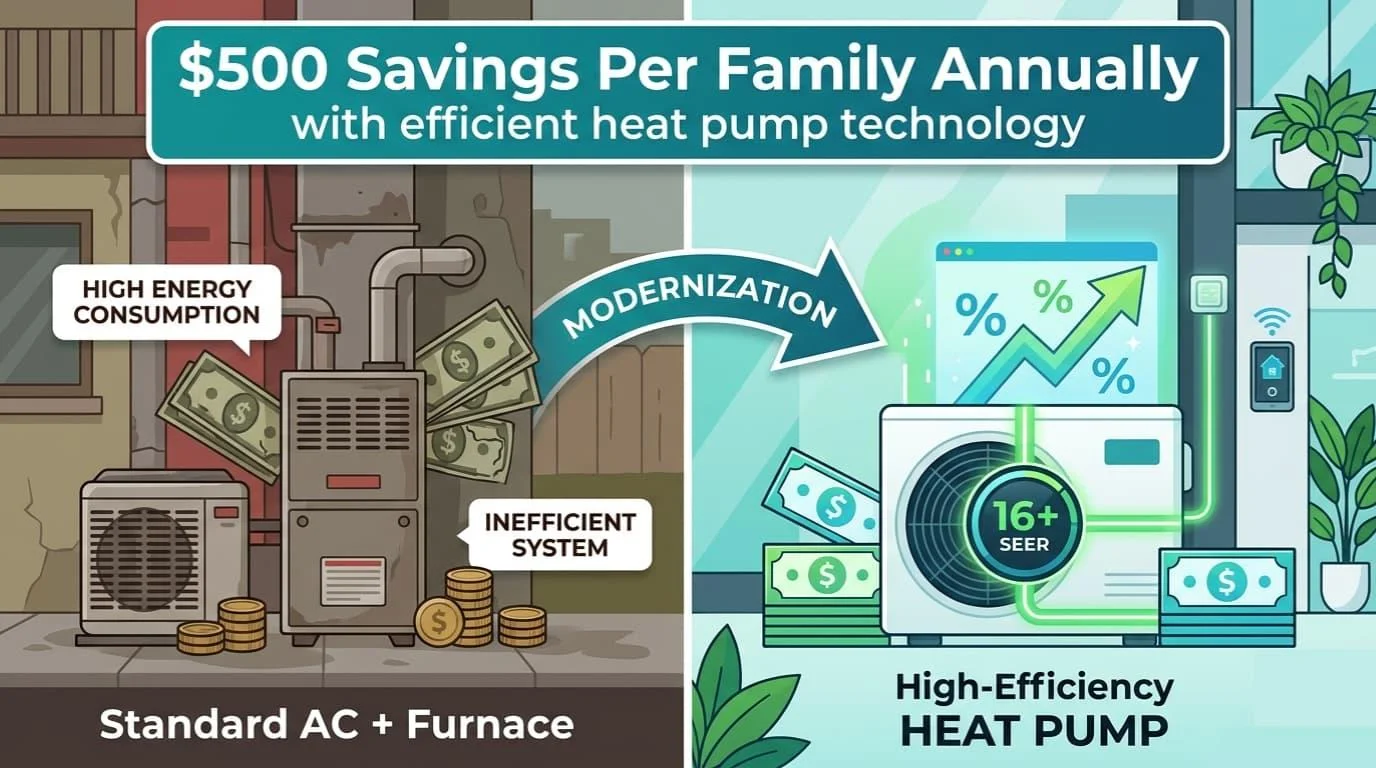
The headline number that surprises most homeowners: a heat pump install in Tampa Bay is typically $1,500 cheaper than a comparable AC + gas furnace install, because you skip the second piece of equipment and the gas plumbing. The federal tax credit then widens that gap by another $2,000.
2026 federal tax credits + Duke and TECO rebates
The Inflation Reduction Act's Section 25C credit gives homeowners 30% of equipment + installation cost, capped at $2,000, on qualifying heat pumps placed in service from 2023 through 2032. The qualifying tier in the South region is CEE Tier 1: SEER2 ≥ 15.2 (ducted), HSPF2 ≥ 7.8, EER2 ≥ 11.7. Most of the heat pumps we install meet this tier by default. We document the equipment AHRI certificate on every quote so your accountant has what they need at tax time.
On top of the federal credit, Duke Energy Florida and TECO each run residential heat-pump rebate programs. Current Duke ranges run $300–$1,000 depending on SEER2 tier and whether you bundle a heat-pump water heater. TECO's program is similar in structure. The rebate amounts and tier requirements update yearly; we pull the current matrix on every quote so you don't have to chase it. We also handle the rebate paperwork - the utility wants the manufacturer model + AHRI number, install date, and a signed homeowner attestation, which we package and submit with the install.
Stack the federal $2,000 + a $700 utility rebate on a $14,000 16 SEER2 heat pump install and you're at $11,300 net. The same-tier AC + electric furnace combo is around $11,500 with no rebates, because traditional ACs without a heating component don't qualify for the IRA Section 25C heat-pump credit.
When the heat pump wins - the four common cases
- You have an existing electric furnace. Roughly 70% of post-1980 Tampa Bay homes. The heat pump wins on operating cost (~$200–$300/year), wins on install cost when you net the federal credit, and wins on equipment count.
- You don't have natural gas at the property line. Bringing gas in is $3,000–$8,000 in trench, pipe, meter, and TECO connection charges before any equipment cost. There's no economic case for a gas furnace at that point.
- You want federal + utility incentives. The IRA credit only applies to heat pumps. Duke and TECO rebates only apply to heat pumps.
- You're decarbonizing or going all-electric. If solar is on your roof or planned, eliminating gas combustion at the house pairs naturally with that.
When traditional AC + gas furnace still wins - three honest cases
- Your existing gas furnace has 5+ good years left and only the AC is failing. A like-for-like AC replacement is $9,500–$13,500. Replacing both with a heat pump is $13,500–$16,500. Operating-cost difference is small in Tampa Bay because gas heat costs are already low.
- You actually like radiant gas heat - and you can afford the install premium. Gas furnaces push 105–120°F supply air; heat pumps deliver 95–105°F. The heat pump's longer, lower-temperature heating cycle is more efficient but feels different. If the comfort difference matters and the budget covers the $1,500–$3,000 install premium, that's a legitimate choice.
- High-load multifamily or large light-commercial property where strip-heat backup capacity exceeds the available electrical service. Rare but real for some 5,000+ sq ft Wesley Chapel and Lutz homes built around horse-property setups.
Salt-air, hurricanes, and the Gulf-proximity penalty
Both systems take the same beating from Tampa Bay's climate, but the corrosion math hits harder if you're inside about 5 miles of the Gulf. Standard outdoor coils start showing salt-air pitting at year 6–8 there; coil-coated coils stretch that to year 10–12. We add the coastal coating package on quotes for any installation address within 5 miles of saltwater, regardless of whether you choose heat pump or AC. The cost is $650–$1,200 either way and it's the single highest-ROI upgrade for a coastal Tampa Bay home.
Hurricane considerations are identical: outdoor condenser elevated above local FEMA flood elevation, anchored to the pad with hurricane straps, connected to whole-house surge protection at the breaker panel. We pull the permit, handle the inspection, and document elevation and tie-down for your home insurer.
The R-454B / R-32 refrigerant transition
January 1, 2025 was the federally-mandated end of new-equipment R-410A production. Every new heat pump and AC sold in Tampa Bay in 2026 ships with one of two replacements: R-454B (Carrier, Trane, Lennox, Bryant, Goodman, American Standard) or R-32 (Rheem, Daikin, some Mitsubishi). Both are A2L-classified, meaning mildly flammable in specific lab conditions - which is why the 2024 Florida mechanical code requires updated leak-detection sensors and revised line-set practices on every install. Both have global-warming-potential roughly 75% lower than R-410A.
Maintenance differences
A heat pump tune-up is two services, not one: cooling-mode tune-up in spring and heat-mode tune-up in fall. The fall visit specifically tests the reversing-valve solenoid, the defrost control sequence, the auxiliary strip current draw, and the outdoor coil clearance for cold-weather airflow. Skipping the fall visit is the single most common reason for "my heat pump worked fine all summer but failed on the first cold night" calls in January.
An AC + gas furnace requires the same cooling-mode tune-up plus a separate gas-furnace tune-up that includes burner inspection, heat-exchanger crack check, gas pressure measurement, CO testing at the registers, and venting-system inspection. The combustion-side work is required by code and by your home insurer.
Our recommendation, by home type
The 80/20 rule on this comparison, based on what we recommend across Tampa Bay:
- Post-2000 single-family home with electric furnace, no gas at meter: heat pump. 90% of cases.
- Post-2000 home with existing working gas furnace less than 8 years old: AC-only replacement matched to existing furnace. 75% of cases.
- Coastal home (within ~5 mi from Gulf): either system, but always with the coil-coating package.
- New construction or full system replacement, no existing equipment to preserve: heat pump, almost always.
- Multifamily, light-commercial, or 5,000+ sq ft residential: Manual-J load calculation and electrical-service check first; AC + gas often wins on these.
- You're planning solar in the next 3 years: heat pump, regardless of other factors.
Want the comparison run on your home? Call Tim and the team at (813) 395-2324 or request a no-obligation in-home consultation. We dispatch from Foamflower Blvd in Wesley Chapel and cover Wesley Chapel, Pasco County, Tampa and Hillsborough County, and Polk County.

Tim founded I Care Air Care in 2010 after 30+ years in the Tampa Bay HVAC trade. EPA Universal certified. The source for all technical guidance published on this site.
Read Tim's full profile →Related local help
These pages connect this guide to the services and local areas homeowners usually need next: