Quick Answer
When duct cleaning helps, when duct sealing matters more, and how Wesley Chapel homeowners should think about indoor air quality.
Start here before you book service
- ✓ Look for dust blowing from registers after cleaning floors.
- ✓ Check whether one room smells musty when the system starts.
- ✓ Ask whether duct sealing or return-air changes would solve the comfort issue better.
- ✓ Clean ducts after construction, attic work, water events, or visible contamination.
Sounds like you need a tech?
(813) 395-2324Duct cleaning is one of the most oversold services in residential HVAC and one of the most under-delivered. In Wesley Chapel's humid climate, done properly and for the right reasons, it makes a real difference - visibly cleaner registers, less dust on furniture, relief for allergy sufferers. Done as a bait-and-switch sales call, it does nothing. This guide helps you tell the difference before scheduling anything.
When duct cleaning actually helps in Wesley Chapel homes
The NADCA (National Air Duct Cleaners Association) position is specific: clean ducts when there's visible contamination, documented mold, pest activity, or post-construction debris - not on a calendar-based schedule. That matters, because plenty of contractors sell duct cleaning as an annual or biannual service when the ducts don't need it.
The scenarios where it genuinely helps: you've had a water event like a burst supply line or overflowed drain pan that got moisture into the ducts; you've just finished a renovation or move-in in a newer Seven Oaks, Epperson, or Mirada home where drywall dust and construction debris are sitting in the supply runs; you've had a pest infestation and there's physical evidence in the ductwork; you have a family member with severe allergies or asthma and the filter alone isn't handling it; you notice a musty smell the moment the AC kicks on, suggesting microbial growth on the coil or in the plenum.
What duct cleaning does not fix: a chronic dust problem caused by a leaky return-air plenum pulling attic dust into the system, high humidity caused by an oversized AC short-cycling, or comfort complaints caused by undersized ductwork. For those issues, AC maintenance and duct sealing or rework are the actual answers.
What's actually in the ducts of a typical Wesley Chapel home
Ten years in Seven Oaks, Meadow Pointe, and Saddlebrook homes gives us a pretty good view of what accumulates in ductwork here versus other parts of the country. Three things show up consistently.
Fine silica and organic dust in the returns. Every return-air boot in a residential system is a low-pressure zone that pulls air through gaps in the drywall, from the attic, and from the gap where the boot meets the duct. Over 5-10 years that brings in a substantial quantity of fine dust - the gray fuzzy coating you see on the back side of a filter grille or on the first few feet of flex inside the return.
Pollen seasons imprint on the duct interior. Wesley Chapel's oak pollen dump (February-April) and grass-pollen summer both push through returns and deposit in the air handler cabinet and first supply run. For allergy sufferers, a pre-pollen-season cleaning can be meaningful.
Microbial growth on the coil and in the plenum. The evaporator coil sits in 48-55°F saturated air for 3,000+ hours a year in Wesley Chapel. The first supply plenum just downstream is also cold and wet. Given organic dust, that's ideal conditions for biofilm and sometimes visible mildew. Cleaning the ducts without addressing the coil and plenum is treating symptoms.
Before saying yes to a duct cleaning quote: ask to see what's in the ducts with a camera before and after, confirm the cleaning includes the evaporator coil and air handler cabinet (not just the grilles), and verify the contractor is using source-removal vacuum plus mechanical agitation. "Spray and pray" chemical treatments without vacuum source-removal do not meet NADCA standards.
What a proper cleaning looks like
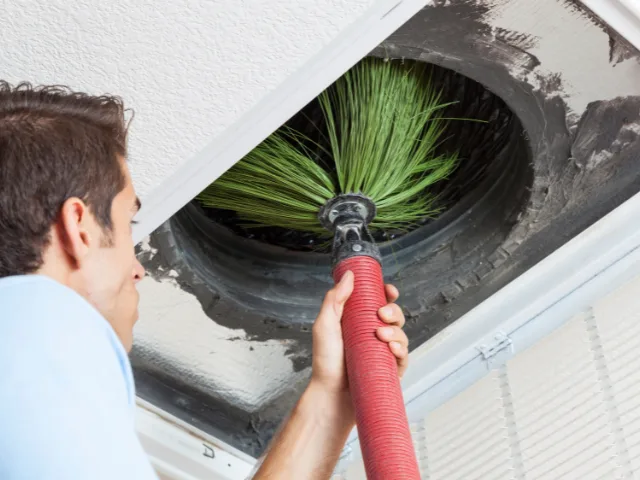
NADCA-compliant cleaning uses source-removal - meaning everything loosened from the duct walls gets pulled out by vacuum, not blown into your living space. A real process:
1. Camera inspection first. Before anything else, a video scope goes down several supply and return runs so you see what's actually in there. No camera, no baseline - we'd rather walk away than guess.
2. Hook up a HEPA-filtered negative-pressure vacuum to the main trunk. Industrial-grade, typically 5,000-8,000 CFM, so everything dislodged gets pulled out of the house. A shop vac in the utility room is not this.
3. Mechanical agitation inside each run. Rotary brushes or pneumatic air whips work the interior walls of the ducts while the negative-pressure system pulls debris out. Every supply and every return, one at a time.
4. Air handler cabinet and evaporator coil. This is where most contractors cut corners. The coil, drain pan, blower wheel, and cabinet interior all need attention. A clean duct feeding a dirty coil is still a dirty system.
5. Optional EPA-registered antimicrobial treatment. Only after physical cleaning, and only if the camera evidence justifies it. Spraying antimicrobials into dust-loaded ducts is theater.
6. Post-cleaning camera inspection. Same runs, same scope, so you see the before and after. Fresh filter installed. System started and airflow verified.
Pricing in Wesley Chapel
NADCA-compliant duct cleaning with coil, cabinet, and blower included runs $450–$900 in a standard 3-5 ton Wesley Chapel home. The wide range reflects home size, number of supply runs, access, and whether microbial treatment is warranted.
- Small home, single system, 8-12 supplies: $450–$650
- Average home, single system, 12-16 supplies: $550–$800
- Larger home or dual-system: $800–$1,400
- Add-on: EPA-registered antimicrobial fog: +$120–$250
- Add-on: UV-C light installation in plenum: +$350–$650
Be wary of the $99 duct cleaning specials that flood Tampa Bay ads every spring. Those are bait prices; the real cost comes from up-sold "extras" that should have been included, or from a service that isn't actually source-removal cleaning at all.
What to do before and after
Replace the filter on the day of service with the correct size and MERV rating for your system. MERV 8 is the baseline for residential; MERV 11-13 is better for allergy sufferers but only if your system can handle the static-pressure increase (most modern systems can, most pre-2010 systems can't without modification).
If the underlying issue was dust from a leaky return, duct cleaning won't solve it on its own - you'll be back to the same dust pattern in 12-18 months. Pair the cleaning with duct sealing or at minimum a return-air plenum inspection so the source of the dust gets addressed. Regular 21-point maintenance also keeps the coil and pan clean so the ducts don't need aggressive intervention as often.
For most Wesley Chapel homes, a duct cleaning every 5-7 years is plenty if maintenance is up to date. Homes with multiple pets, serious allergies, or recent renovation may benefit from a 3-year cadence.
If you're seeing dust trails around supply registers or smelling something musty when the AC kicks on, give Tim and the team a call at (813) 395-2324. We'll scope the ducts first, show you what's there, and only recommend cleaning if the camera says it's warranted. Wesley Chapel appointments usually open within 3-5 business days.
.webp "Tim Hawk, Owner of I Care Air Care")
Tim founded I Care Air Care in 2010 after 30+ years in the Tampa Bay HVAC trade. EPA Universal certified. The source for all technical guidance published on this site.
Read Tim's full profile →Related local help
These pages connect this guide to the services and local areas homeowners usually need next: